1776 · Lake Champlain, United States
The Battle of Valcour Island, a naval engagement during the American Revolutionary War, takes place on Lake Champlain.
July 29, 1609
Samuel de Champlain engages in a battle against the Iroquois, marking one of the first documented uses of firearms by Europeans in North America.
Lake Champlain, United States | French colonial forces
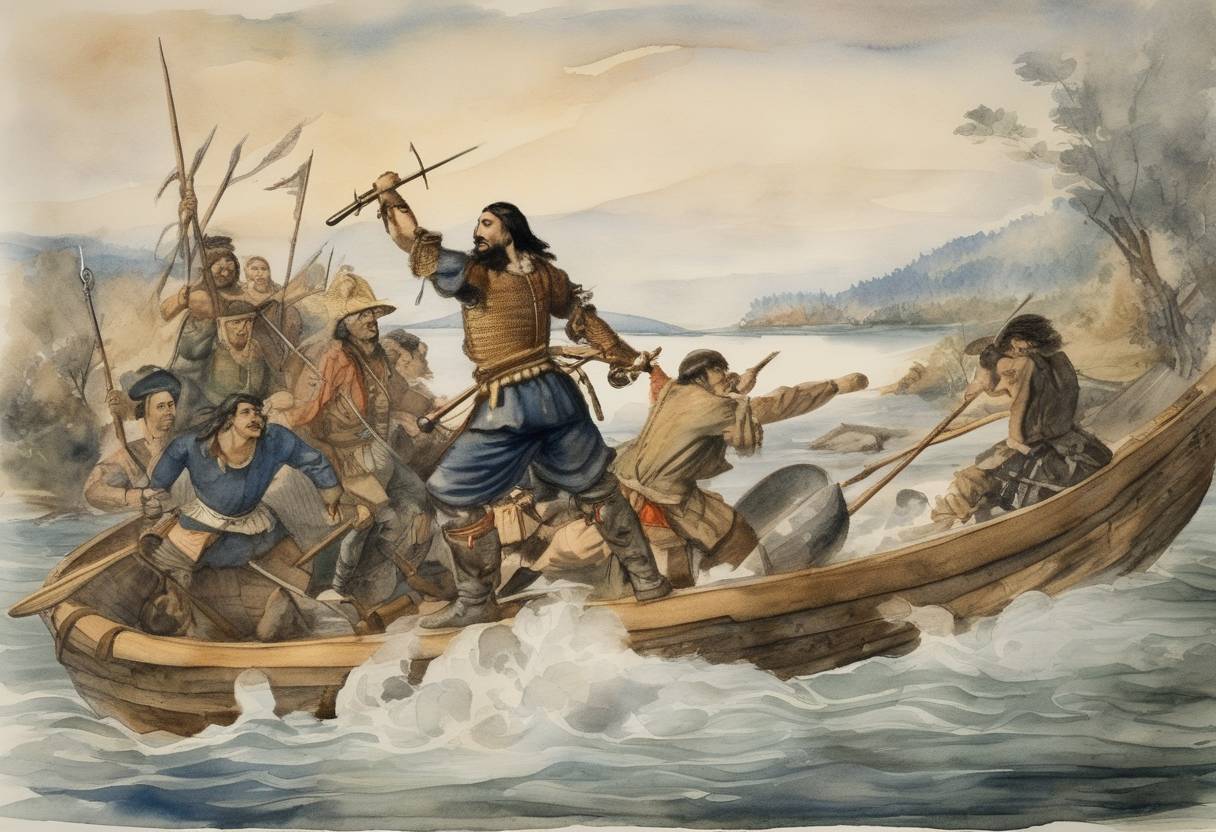
On July 29, 1609, the French explorer Samuel de Champlain engaged in a battle against the Iroquois, a moment that marked one of the first documented European uses of firearms in North America. This pivotal event took place on the shores of what is now Lake Champlain, named in honor of Champlain himself.
Samuel de Champlain, a key figure in the establishment of French colonies in the New World, had allied with several indigenous groups, including the Algonquin, Montagnais, and Huron peoples. These tribes were traditional enemies of the Iroquois Confederacy, known for their strength and strategic prowess across the northeastern region of what is now the United States and southeastern Canada.
Champlain’s alliances were motivated by mutual interests: the indigenous partners sought aid in their conflict against the Iroquois, while Champlain was interested in expanding the fur trade and gaining strategic allies for France’s colonial endeavors.
On the day of the battle, Champlain and his indigenous allies encountered a group of Iroquois warriors near the southern tip of Lake Champlain. The battle formation saw the Iroquois positioned defensively in a clearing, prepared for confrontation.
As the confrontation unfolded, Champlain’s use of an arquebus—a type of early firearm—became a decisive factor. He fired upon the Iroquois, killing two chiefs with a single shot. The commotion caused by the discharge of Champlain’s firearm, along with the unfamiliar sound and lethality of the weapon, created chaos among the Iroquois ranks. This technological advantage contributed significantly to the swift victory of Champlain’s side.
The engagement had long-term consequences for the region. It intensified animosities between the French and the Iroquois Confederacy, setting the stage for future conflicts as the Iroquois sought retribution in subsequent years. The battle also highlighted the disparity in military technology between European colonizers and indigenous peoples, a factor that would play a crucial role in shaping the colonial dynamics in North America.
Champlain’s involvement in this conflict and his role in using firearms had lasting impacts on French-Iroquois relations and underscored the complex alliances and enmities that characterized the early years of European colonization in North America.
Source: www.history.com