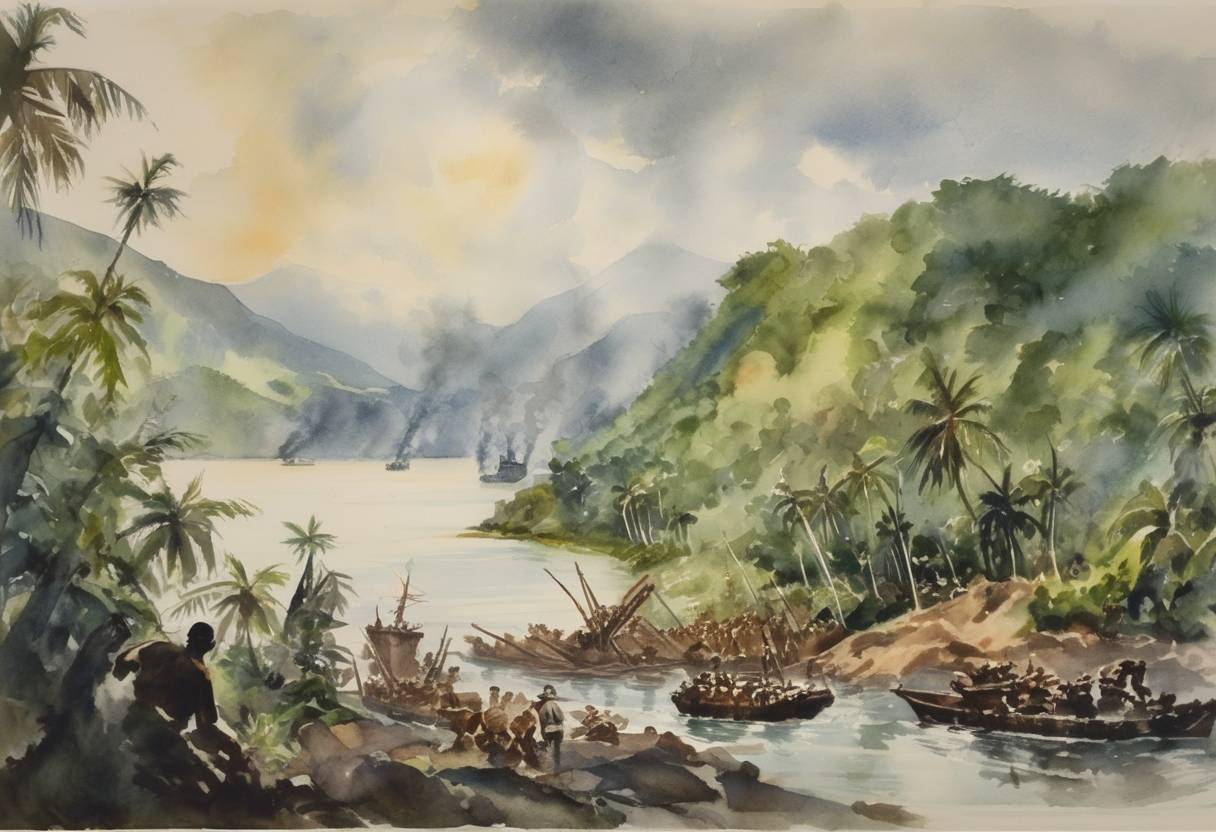
Battle of Rabaul: January 31, 1942
Context
The Battle of Rabaul was a crucial engagement during the Pacific Campaign of World War II. Situated on the island of New Britain, Rabaul held significant strategic value due to its natural deep-water harbor and its location, which facilitated control over sea lanes between Japan and Australia. Securing Rabaul allowed the Japanese to establish a forward base for continued operations in the Pacific.
Prelude
In the wake of the Pearl Harbor attack on December 7, 1941, Japanese forces initiated a series of aggressive campaigns across the Pacific. By January 1942, Japan had already captured key territories in Southeast Asia and was poised to expand southward. Rabaul, defended by a relatively small Australian force known as Lark Force, became a primary target as part of Japan’s broader strategy to isolate Australia from Allied support.
The Battle
On January 23, 1942, the Japanese South Seas Force, led by Major General Tomitarō Horii, began their assault on Rabaul. This force, comprised of approximately 5,000 troops, made a series of amphibious landings along the northern coast of New Britain. Despite determined but vastly outnumbered resistance from Lark Force, consisting of about 1,400 personnel, including soldiers of the Australian 22nd Infantry Battalion, the Japanese forces swiftly advanced.
By January 31, 1942, Rabaul had fallen completely under Japanese control after intense but brief fighting. The overwhelming Japanese force, equipped with superior arms and supported by air power, quickly subdued the Australian defenders, many of whom were captured or killed.
Aftermath
The capture of Rabaul provided Japan with a vital stronghold in the South Pacific. They quickly set about establishing Rabaul as a major base, fortifying it with airfields, a submarine base, and extensive supply and medical facilities. This allowed them to threaten Allied operations in the region, particularly in relation to the Solomon Islands and New Guinea.
The subsequent siege and Allied attempts to neutralize Rabaul consumed significant resources over the following years. Although bypassed by later Allied advances, Rabaul remained a thorn in Allied strategic planning until the end of the war, effectively isolated but heavily fortified.
Historical Significance
The fall of Rabaul highlighted the vulnerability of Allied positions in the Pacific early in the war and underscored the pressing need for coordinated defensive strategies and reinforcements. It also marked the beginning of Japan’s southern thrust, which played a crucial role in shaping the Pacific Campaign’s subsequent course and was a pivotal reminder of the importance of air and naval supremacy.
The battle is remembered not only for its military implications but also for the harsh conditions endured by prisoners of war and the local population during the Japanese occupation.