1880 · Kampot, Cambodia
The Treaty of Kampot is signed between France and Cambodia leading to further French influence and colonial control over Cambodia.
May 17, 1642
Paul de Chomedey, Sieur de Maisonneuve, establishes Ville-Marie, which later becomes Montreal.
Montreal, Canada | Society of Notre-Dame de Montréal
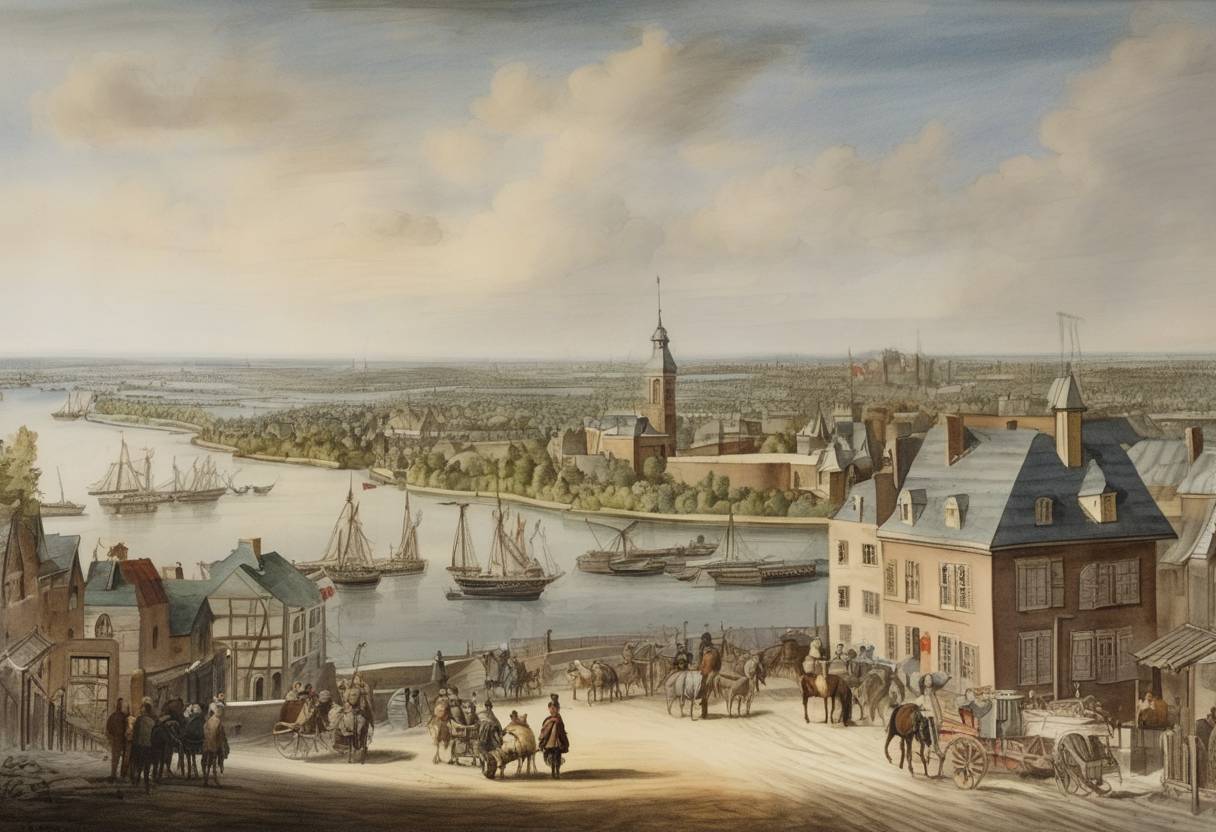
On May 17, 1642, Paul de Chomedey, Sieur de Maisonneuve, a key figure in the early colonization of French Canada, established the settlement of Ville-Marie on the island of Montreal. This event is a cornerstone in Canadian history as Ville-Marie would eventually grow to become the vibrant city of Montreal.
In the early 17th century, France was expanding its presence in the New World through exploration and the establishment of settlements. The intention behind creating Ville-Marie was not solely for economic gains. Unlike other colonial enterprises focusing on fur trade or resource extraction, Ville-Marie was envisioned as a missionary outpost.
The Société Notre-Dame de Montréal, a religious organization founded by devout Catholics Jérôme Le Royer de La Dauversière and Jean-Jacques Olier, sponsored this settlement. They aimed to spread Christianity among Indigenous peoples and establish a model Christian community in North America. Paul de Chomedey, known for his devout nature and leadership qualities, was chosen to lead this mission.
Accompanied by Jeanne Mance, a pioneering woman who played a crucial role in the settlement’s healthcare establishment, Maisonneuve and an initial group of settlers arrived at the location. Situated on the strategic Island of Montreal, Ville-Marie was initially conceived as a fortified mission village. On May 17, 1642, Maisonneuve and his settlers held a mass, marking the ceremonial and spiritual foundation of the community. This religious ceremony underscored the settlement’s dual role as both a habitation and a missionary centre.
The newly established Ville-Marie faced numerous challenges, including harsh weather conditions, food shortages, and constant threats from local Indigenous groups, particularly the Iroquois Confederacy. Despite these difficulties, the resolve of Maisonneuve and his settlers remained steadfast. Jeanne Mance founded the Hôtel-Dieu de Montréal hospital in 1645, ensuring the new community had essential medical care and emphasizing the settlement’s role as a humanitarian project.
As Ville-Marie underwent gradual expansion, it developed into a crucial hub for trade and exploration. Over the years, its strategic location fostered growth in population and influence. The settlement remained predominantly French-Canadian, playing a significant role in maintaining French cultural and linguistic roots despite British conquest later on.
Eventually, Ville-Marie evolved into the modern city of Montreal, becoming one of Canada’s largest and most culturally diverse urban centers, while continuing to celebrate its foundational event on May 17, marking its inception annually as a pivotal moment in Canadian history.
Source: www.thecanadianencyclopedia.ca