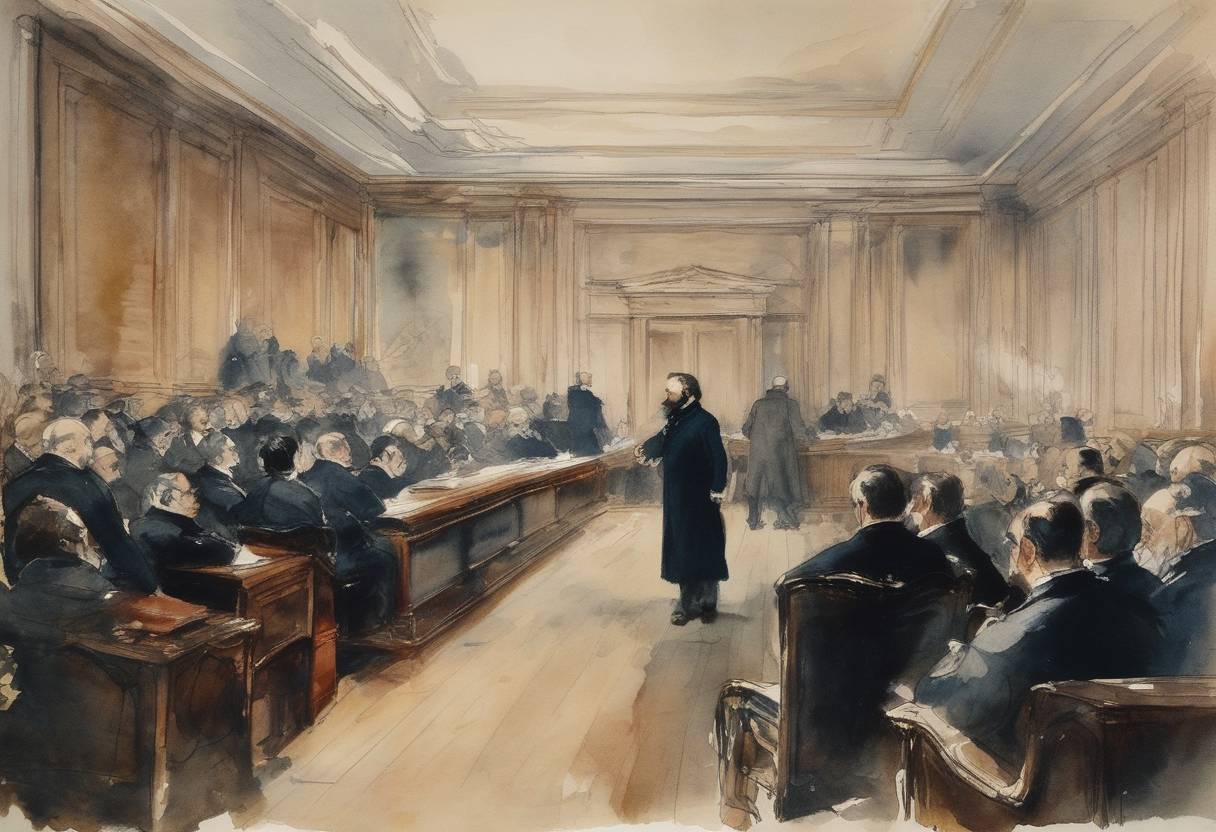
Émile Zola’s Libel Trial: February 7, 1898
On February 7, 1898, the renowned French writer Émile Zola was brought to trial for libel after publishing his incendiary open letter, “J’accuse…!” In this letter, Zola accused the French government and military of anti-Semitism and the wrongful conviction of Captain Alfred Dreyfus, a Jewish officer in the French Army.
Context
The trial stemmed from the broader controversy known as the Dreyfus Affair, which began in 1894 when Captain Alfred Dreyfus was accused and convicted of treason for allegedly passing military secrets to Germany. Despite scant evidence, he was sentenced to life imprisonment on Devil’s Island. The conviction was heavily tainted by anti-Semitic sentiment, as Dreyfus was one of the few Jewish members in the French military high command.
As evidence of Dreyfus’s innocence began to surface, the divide between supporters and opponents of Dreyfus sharpened into a significant political and social conflict in France. Dreyfusards, like Zola, were often intellectuals, linked with progressive values, while anti-Dreyfusards included conservatives and nationalists who championed the army’s decision.
Émile Zola and “J’accuse…!”
Émile Zola, appalled by the miscarriage of justice and motivated by his dedication to truth and justice, decided to speak out. On January 13, 1898, he published “J’accuse…!” as a front-page open letter in the newssheet L’Aurore. The letter directly accused the army, judiciary, and President Félix Faure’s administration of authoritarianism and bigotry, instigating a public uproar.
The Trial
Zola’s letter not only shook the public’s perception but also led to his trial on libel charges on February 7, 1898. During the trial, Zola was represented by a team of skilled lawyers and faced a government keen to defend its institutions. The trial was a public spectacle, attended by intellectuals and politicians, and intensely covered by the press.
The prosecution argued that Zola’s allegations were defamatory and posed a threat to the nation’s integrity and stability. Zola defended his letter as a courageous act to promote justice and democracy, highlighting systemic issues of anti-Semitism and corruption.
Aftermath and Significance
Despite his compelling defense, Zola was convicted of libel on February 23, 1898, sentenced to a fine, and a year-long prison term. To avoid imprisonment, Zola fled to England, continuing to actively support the cause for Dreyfus’s exoneration.
Zola’s “J’accuse…!” and subsequent trial catalyzed international attention and support for Dreyfus. The affair ultimately led to a reevaluation and appeals to hardware justice reforms in France. In 1906, Alfred Dreyfus was exonerated and reinstated into the French Army.
Zola’s stand in the Dreyfus Affair remains a seminal example of intellectual courage and the power of the press to challenge injustice and governmental malpractice.