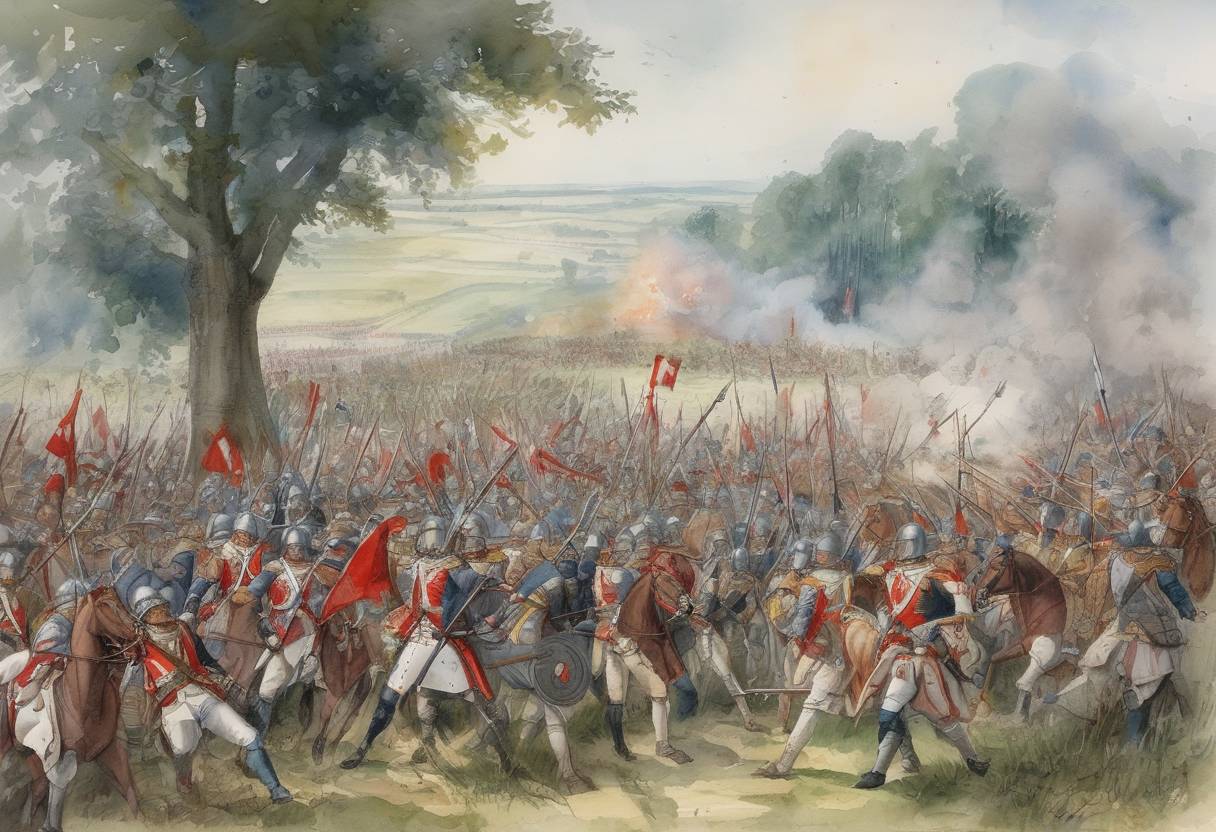
The Battle of Fontenoy - June 25, 841
The Battle of Fontenoy, fought on June 25, 841, was a pivotal conflict during the Carolingian Civil War, a series of power struggles among the grandsons of Charlemagne. This battle was a significant event in the fracturing of the Carolingian Empire, which had been one of the most powerful entities in medieval Europe.
Background
The Carolingian Civil War was primarily a conflict among the sons of Louis the Pious, Charlemagne’s successor. Upon Louis’s death in 840, his empire was divided among his sons: Lothair I, Charles the Bald, and Louis the German. Lothair, as the eldest, claimed the title of Holy Roman Emperor and sought to assert dominance over his brothers, leading to escalating tensions and eventual warfare.
The Battle
- Location: The battle took place near Fontenoy-en-Puisaye, in present-day France.
- Combatants: The forces were divided between Lothair I, who was allied with his nephew Pepin II of Aquitaine, and the combined armies of his brothers, Charles the Bald and Louis the German.
- Forces: The exact numbers are uncertain, but contemporary accounts suggest that tens of thousands of soldiers were involved, making it one of the largest battles of the era.
Key Events
- Strategic Movements: Charles the Bald and Louis the German coordinated their forces to confront Lothair’s army, which was attempting to consolidate control over the empire.
- Battle Tactics: The battle was characterized by traditional medieval warfare tactics, including cavalry charges and infantry engagements.
- Outcome: The battle ended in a decisive victory for Charles the Bald and Louis the German. Lothair’s forces were routed, and he was forced to retreat.
Aftermath
- Political Consequences: The defeat significantly weakened Lothair’s position and led to further negotiations among the brothers.
- Treaty of Verdun: The battle set the stage for the Treaty of Verdun in 843, which formally divided the Carolingian Empire into three distinct kingdoms, laying the groundwork for the modern states of France and Germany.
- Historical Significance: The fragmentation of the empire marked the decline of centralized Carolingian power and the rise of regional kingdoms, influencing the political landscape of medieval Europe.
The Battle of Fontenoy is remembered as a turning point in the Carolingian Civil War, illustrating the complexities of succession and the challenges of maintaining a vast empire in the medieval period.