The Battle of the Plains of Abraham
1759 · Quebec City, Canada
The Battle of the Plains of Abraham took place during the Seven Years' War, leading to the British capture of Quebec City from the French.
July 26, 1758
The Siege of Louisbourg ended with a British victory, which was a pivotal moment in the Seven Years' War, leading to British control over the French fortress.
Louisbourg, Canada | British Army
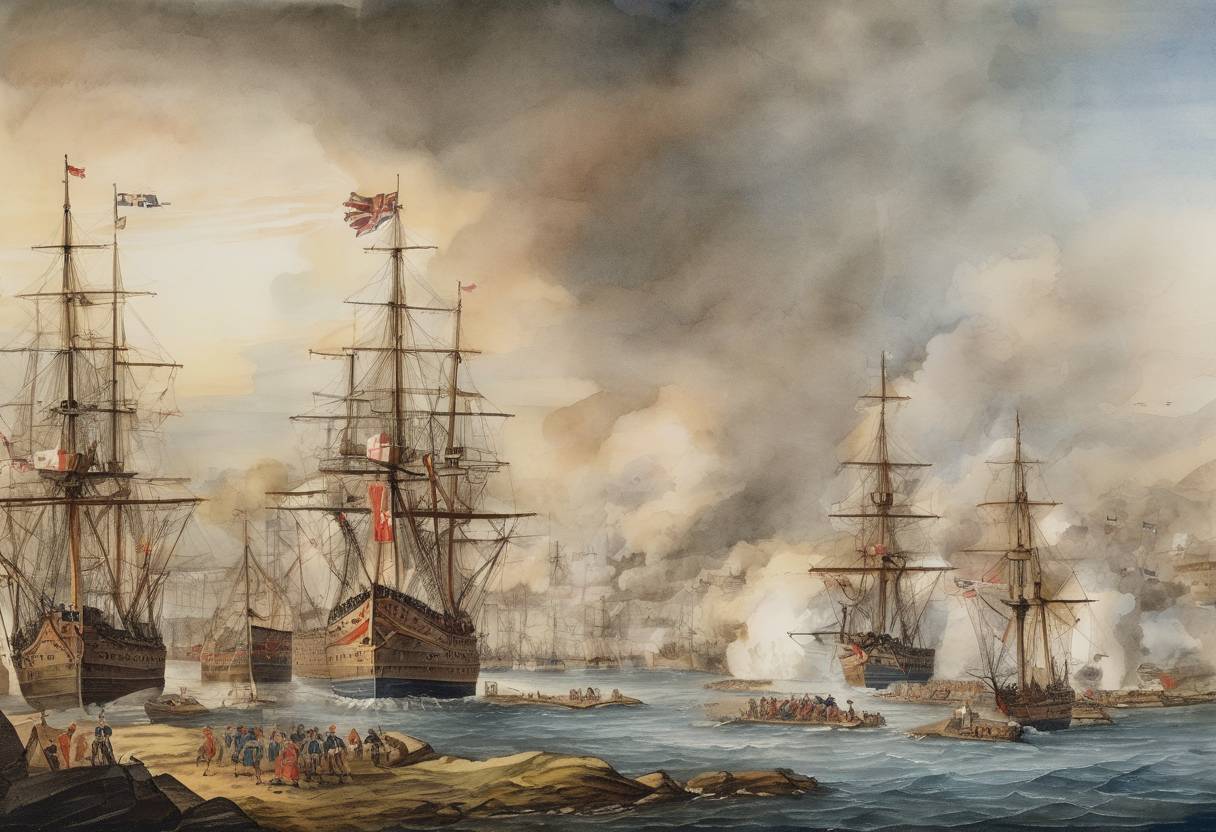
The Siege of Louisbourg, which concluded on July 26, 1758, was a significant military engagement during the Seven Years’ War, a global conflict that spanned from 1756 to 1763. The fortress of Louisbourg, located on Cape Breton Island in present-day Nova Scotia, was a strategic French stronghold guarding the entrance to the Gulf of St. Lawrence. Its capture was crucial for the British as it opened the way for an assault on Quebec, the heart of French Canada.
Strategic Importance: Louisbourg was vital for the French as it protected their fishing grounds and served as a base for naval operations in the North Atlantic. For the British, capturing Louisbourg was essential to gaining control over the North American territories and disrupting French supply lines.
British Preparations: In 1758, British Prime Minister William Pitt the Elder prioritized the capture of Louisbourg as part of a broader strategy to weaken French power in North America. A formidable British force was assembled, consisting of approximately 14,000 troops and a fleet of 39 warships under the command of General Jeffrey Amherst and Admiral Edward Boscawen.
Commencement: The siege began in early June 1758. The British forces landed near Louisbourg and began a systematic campaign to encircle and bombard the fortress.
Tactics and Warfare: The British employed a combination of naval bombardment and land assaults. The French defenders, numbering around 3,500 troops, were outmatched and struggled to repel the British advances.
Surrender: After weeks of relentless bombardment and the destruction of their defensive positions, the French garrison, commanded by Chevalier de Drucour, surrendered on July 26, 1758. The British victory was decisive, with minimal losses compared to the French.
Strategic Gain: The fall of Louisbourg was a turning point in the Seven Years’ War in North America. It allowed the British to control the approaches to the St. Lawrence River, paving the way for the subsequent campaign against Quebec in 1759.
Impact on French Morale: The loss of Louisbourg was a severe blow to French morale and their strategic position in North America. It marked the beginning of the end for French colonial ambitions on the continent.
Broader Historical Context: The capture of Louisbourg demonstrated the effectiveness of British military strategy and contributed to their eventual victory in the Seven Years’ War. The war’s outcome significantly reshaped the geopolitical landscape, leading to British dominance in North America and setting the stage for future conflicts, including the American Revolutionary War.
In summary, the Siege of Louisbourg was a critical event that underscored the shifting balance of power during the Seven Years’ War, with lasting implications for the future of North America.
Source: en.wikipedia.org