The Death of King Carloman II and the Unification of the Frankish Kingdom
884 · Les Andelys, West Francia
King Carloman II of West Francia dies, leading to the eventual unification of the Frankish kingdom under Charles the Fat.
April 10, 0879
Louis III and Carloman II become joint kings of the Western Franks following the death of their father, Louis the Stammerer.
Compiègne, West Francia | Carolingian Dynasty
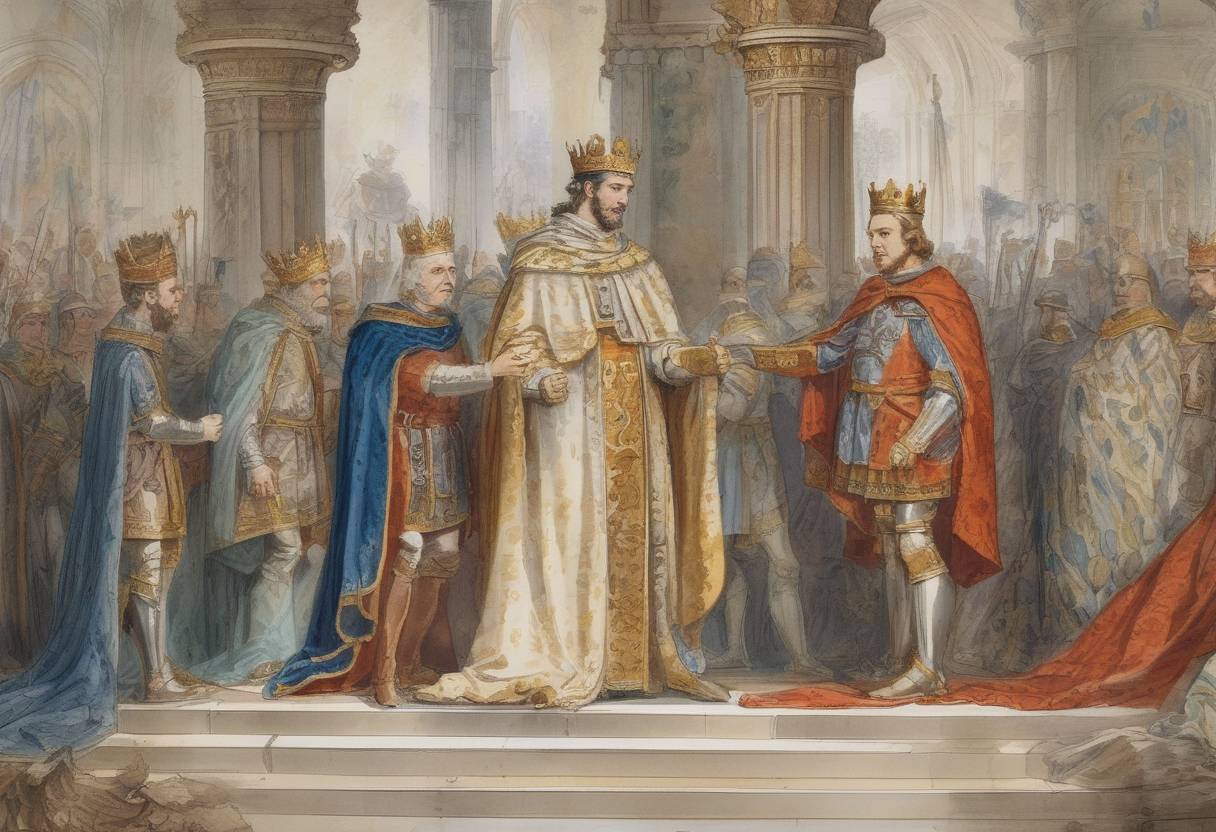
On April 10, 879, Louis III and Carloman II ascended to the throne as joint kings of the Western Franks following the death of their father, Louis the Stammerer. This event marked a significant moment in the Carolingian dynasty, which was characterized by the division of territories among heirs, a practice that often led to internal conflicts and shifting power dynamics.
Louis the Stammerer: Their father, Louis the Stammerer, was the King of West Francia from 877 until his death in 879. His reign was relatively short and marked by attempts to consolidate power amidst the fragmentation of the Carolingian Empire.
Carolingian Dynasty: The Carolingian dynasty, founded by Charlemagne, was known for its tradition of dividing the empire among sons, which often resulted in weakened centralized power and internal strife.
Joint Kingship: Upon Louis the Stammerer’s death, his sons, Louis III and Carloman II, were crowned as joint kings. This division of power was a continuation of the Carolingian practice of partitioning territories among heirs.
Coronation: The brothers were crowned in September 879 at Ferrières Abbey, a significant ecclesiastical center, which underscored the church’s role in legitimizing royal authority during this period.
Territorial Division: The brothers initially ruled different parts of the kingdom, with Louis III controlling the northern regions and Carloman II the southern areas. This division was intended to manage the vast territories more effectively but also posed challenges in maintaining unity.
External Threats: Their reign was marked by external threats, particularly from Viking incursions, which were a persistent problem for the Frankish kingdoms during this era.
Internal Strife: The joint kingship faced internal challenges, including the need to assert control over powerful nobles and maintain the loyalty of regional leaders.
Louis III’s Death: Louis III died in 882, leaving Carloman II as the sole ruler until his own death in 884. Their deaths without direct heirs led to further instability and the eventual rise of Charles the Fat, who briefly reunited the Carolingian Empire.
Legacy: The reign of Louis III and Carloman II is often seen as a period of transition within the Carolingian dynasty, highlighting the difficulties of maintaining a cohesive empire amidst internal divisions and external pressures.
The joint kingship of Louis III and Carloman II reflects the complexities of medieval European politics, where dynastic traditions and external threats shaped the course of history. Their reign underscores the challenges faced by the Carolingian rulers in preserving the legacy of Charlemagne’s empire.
Source: en.wikipedia.org