Hubert Cecil Booth Patents the First Powered Vacuum Cleaner
1901 · London, United Kingdom
Hubert Cecil Booth patented the first powered vacuum cleaner.
October 3, 1899
J.S. Thurman of the United States patented the motor driven vacuum cleaner. This was one of the early advances in household cleaning technology.
St. Louis, United States | U.S. Patent Office
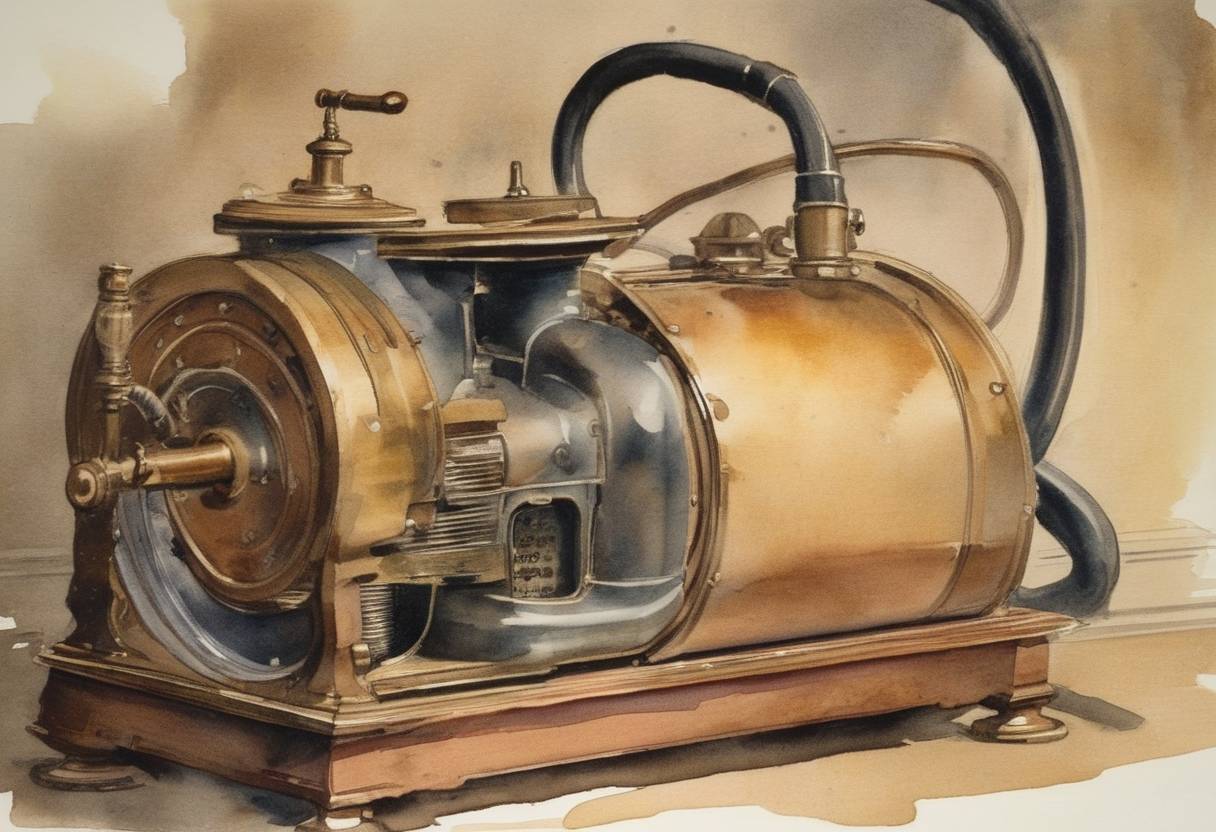
On October 3, 1899, J.S. Thurman, an inventor from the United States, received a patent for a motor-driven vacuum cleaner. This innovation marked a significant advancement in household cleaning technology, contributing to modern cleaning practices.
John S. Thurman was an inventor primarily focused on improving household efficiency through mechanization. His patent represented one of the early efforts to utilize motor power to ease the traditionally manual task of cleaning.
Thurman’s machine, covered by his patent, was not entirely akin to modern vacuum cleaners. Instead of being a portable household appliance, it was a gasoline-powered device that operated on a more cumbersome scale. The machine functioned by blowing dust into a receptacle, rather than the suction method used in contemporary designs.
At the time of Thurman’s invention, household cleaning largely relied on manual labor, with brooms and brushes being the primary tools. Thurman’s development offered a glimpse into the future of powered cleaning devices.
Although Thurman’s design did not achieve mass commercial success, it set the stage for further development and innovation in vacuum technology. The concept of mechanized cleaning inspired subsequent inventors, including Hubert Cecil Booth and James Murray Spangler, who contributed to the evolution of the vacuum cleaner into an indispensable household appliance.
The patent awarded to J.S. Thurman on October 3, 1899, signifies an early and critical step in the modernization of domestic cleaning tools. It reflects the late 19th and early 20th-century trend of mechanization that transformed household labor, paving the way for the efficient, user-friendly cleaning appliances we utilize today.
Source: patents.google.com