Voyager 2's Closest Approach to Uranus - January 24, 1986
1986 · Pasadena, United States
The Voyager 2 spacecraft made its closest approach to Uranus, providing the first detailed images of the planet and its moons.
March 10, 1977
Astronomers discover rings around Uranus.
Pasadena, United States | NASA
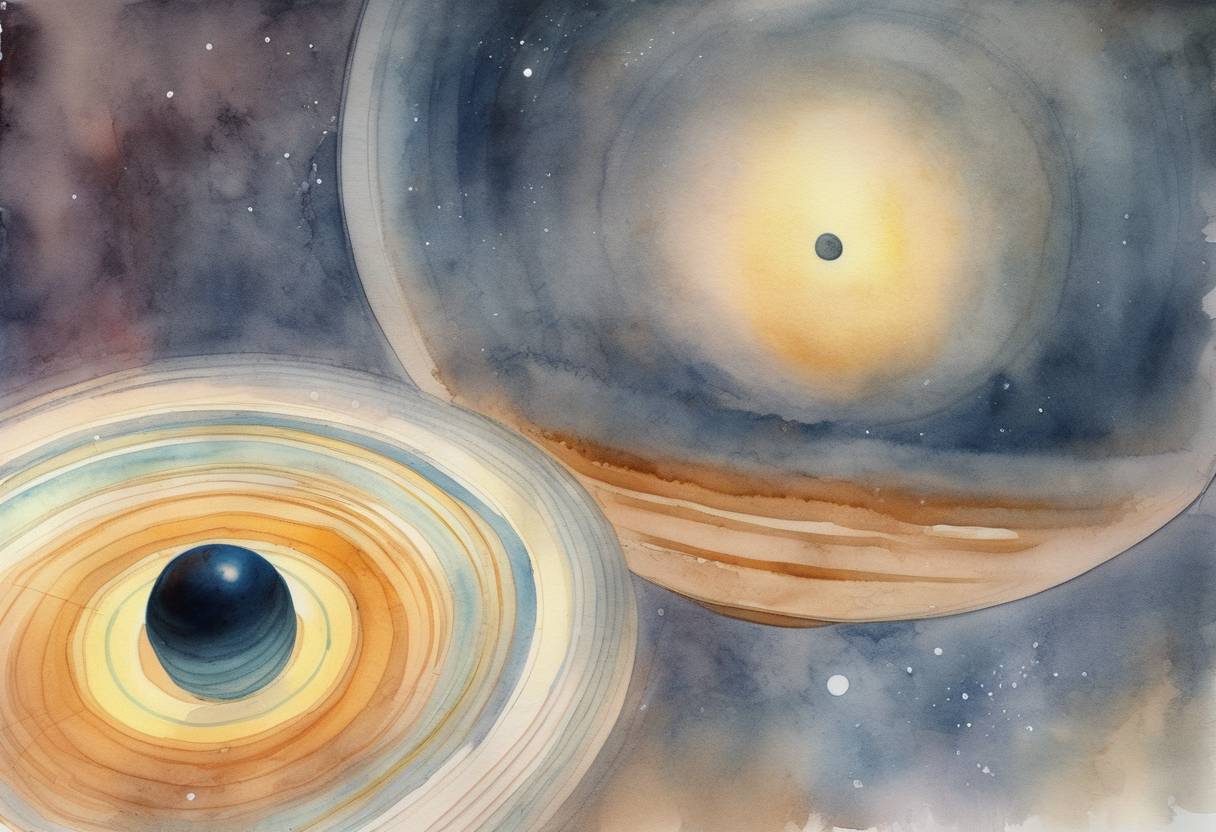
On March 10, 1977, astronomers James L. Elliot, Edward W. Dunham, and Douglas J. Mink made a groundbreaking discovery that expanded our understanding of the solar system: the rings around the planet Uranus. This discovery was significant as it challenged the previous notion that Saturn was the only planet in our solar system with a ring system.
Before 1977, Saturn was the only known planet with a prominent ring system, which had been observed since the 17th century. The discovery of rings around Uranus was unexpected and marked a pivotal moment in planetary astronomy, prompting scientists to reconsider the characteristics and formation of ring systems around planets.
The discovery occurred during an astronomical event known as an occultation, where Uranus passed in front of a distant star, SAO 158687. The astronomers were using the Kuiper Airborne Observatory, a high-altitude aircraft equipped with a telescope, to observe this event. As Uranus moved in front of the star, they noticed that the star’s light dimmed several times before and after the planet’s occultation. This dimming indicated the presence of rings, as the light was being blocked by the material in the rings.
The initial discovery identified five distinct rings, which were later named Alpha, Beta, Gamma, Delta, and Epsilon. Subsequent observations and missions, such as the Voyager 2 flyby in 1986, revealed additional rings and provided more detailed information about their composition and structure. The rings of Uranus are primarily composed of dark, narrow bands of particles, which are believed to be made up of water ice mixed with darker material.
The discovery of Uranus’s rings had several important implications:
Broadened Understanding of Planetary Rings: It demonstrated that ring systems are not unique to Saturn and may be more common in the solar system than previously thought.
Stimulated Further Research: This finding encouraged astronomers to investigate other planets for similar features, leading to the discovery of rings around Jupiter and Neptune.
Enhanced Knowledge of Uranus: The rings provided insight into the planet’s gravitational field and its history, offering clues about the processes that may have led to their formation.
The discovery of rings around Uranus on March 10, 1977, was a landmark event in the field of astronomy. It not only expanded our understanding of the solar system but also highlighted the dynamic and diverse nature of planetary systems. This finding continues to influence astronomical research and our comprehension of planetary formation and evolution.
Source: en.wikipedia.org