Recognition of the Cuban Government by the United States on January 7, 1959
1959 · Havana, Cuba
The United States recognized the new Cuban government of Fidel Castro.
January 1, 1959
Fidel Castro's forces overthrow the government of Cuban dictator Fulgencio Batista, marking the beginning of Castro's rule in Cuba.
Havana, Cuba | 26th of July Movement
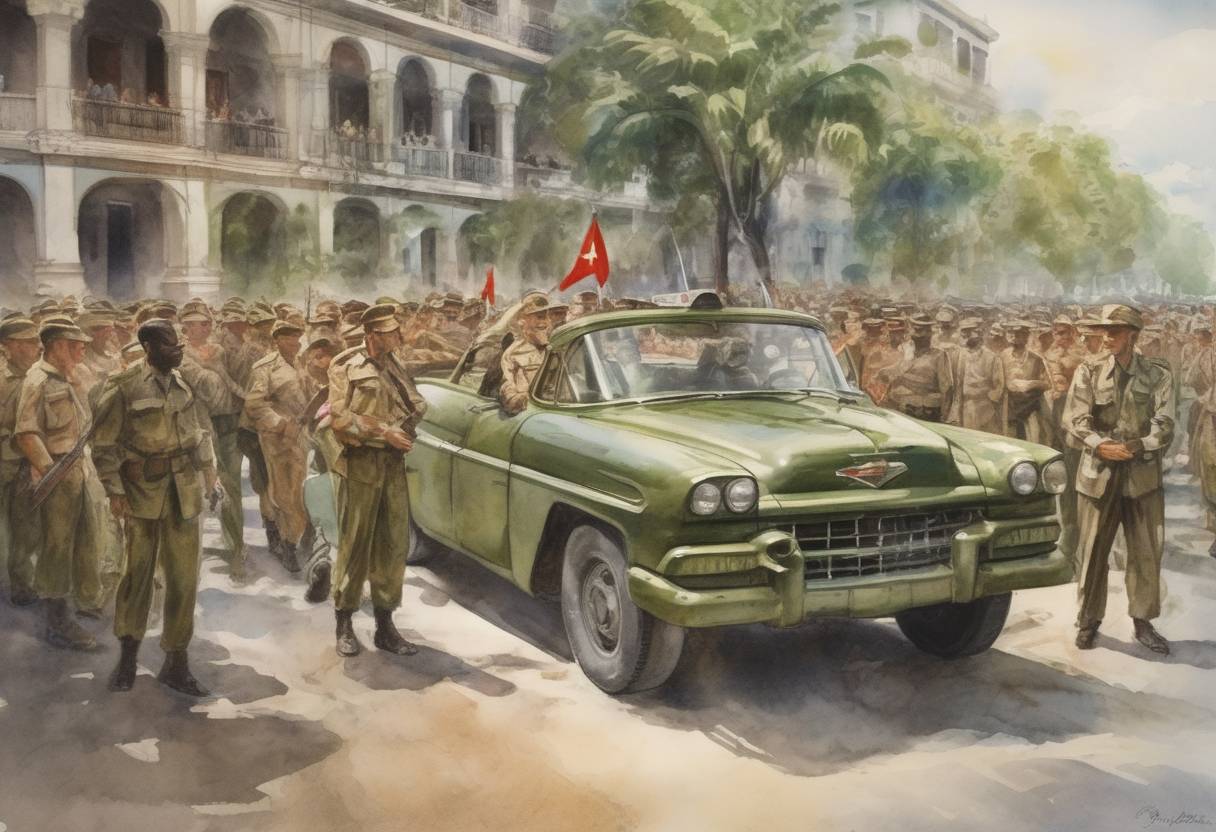
On January 1, 1959, Fidel Castro’s revolutionary forces successfully overthrew the government of Cuban dictator Fulgencio Batista, marking a pivotal moment in Cuban history and the beginning of Castro’s rule.
Fulgencio Batista had been a dominant figure in Cuban politics since the 1930s, initially as a military leader and later as an elected president. However, his return to power through a coup in 1952 led to a dictatorial regime characterized by corruption, repression, and close ties with American business interests. This environment of political oppression and economic disparity fueled widespread discontent among the Cuban populace.
The seeds of revolution were sown in 1953 when Fidel Castro, a young lawyer, led an unsuccessful attack on the Moncada Barracks in Santiago de Cuba. Although the attack failed, it marked the beginning of the Cuban Revolution. Castro was imprisoned but later released in 1955 under a general amnesty. He then went into exile in Mexico, where he regrouped with fellow revolutionaries, including Ernesto “Che” Guevara.
In December 1956, Castro and his group, known as the 26th of July Movement, landed in Cuba aboard the yacht Granma. Despite initial setbacks, including a disastrous landing and loss of many fighters, the movement gradually gained support from the rural population and expanded its guerrilla warfare tactics against Batista’s forces.
By late 1958, Castro’s forces had gained significant momentum, capturing key cities and winning crucial battles. Batista’s regime, weakened by internal corruption, loss of popular support, and military defeats, was unable to withstand the revolutionary onslaught. On December 31, 1958, Batista fled Cuba for the Dominican Republic, leaving the government in disarray.
On January 1, 1959, Castro’s forces entered Havana, effectively taking control of the country. This marked the end of Batista’s rule and the beginning of a new era under Castro’s leadership.
Fidel Castro’s rise to power had profound implications for Cuba and the world. Under his leadership, Cuba underwent significant social and economic transformations, including land reforms, nationalization of industries, and improvements in education and healthcare. However, Castro’s alignment with the Soviet Union and the establishment of a one-party socialist state led to strained relations with the United States, culminating in events such as the Bay of Pigs invasion and the Cuban Missile Crisis.
The Cuban Revolution inspired leftist movements across Latin America and beyond, symbolizing resistance against imperialism and dictatorial regimes. However, it also sparked debates about human rights and political freedoms under Castro’s government, which remains a contentious topic to this day.
In summary, the overthrow of Batista on January 1, 1959, was a turning point in Cuban history, ushering in decades of revolutionary rule under Fidel Castro and reshaping the geopolitical landscape of the Cold War era.
Source: en.wikipedia.org