Austria-Hungary Declares War on Russia: August 6, 1914
1914 · Vienna, Austria-Hungary
Austria-Hungary declared war on Russia, escalating the conflict that became World War I.
June 28, 1914
Archduke Franz Ferdinand of Austria and his wife Sophie were assassinated in Sarajevo, an event that precipitated the outbreak of World War I.
Sarajevo, Bosnia and Herzegovina | Austro-Hungarian Empire
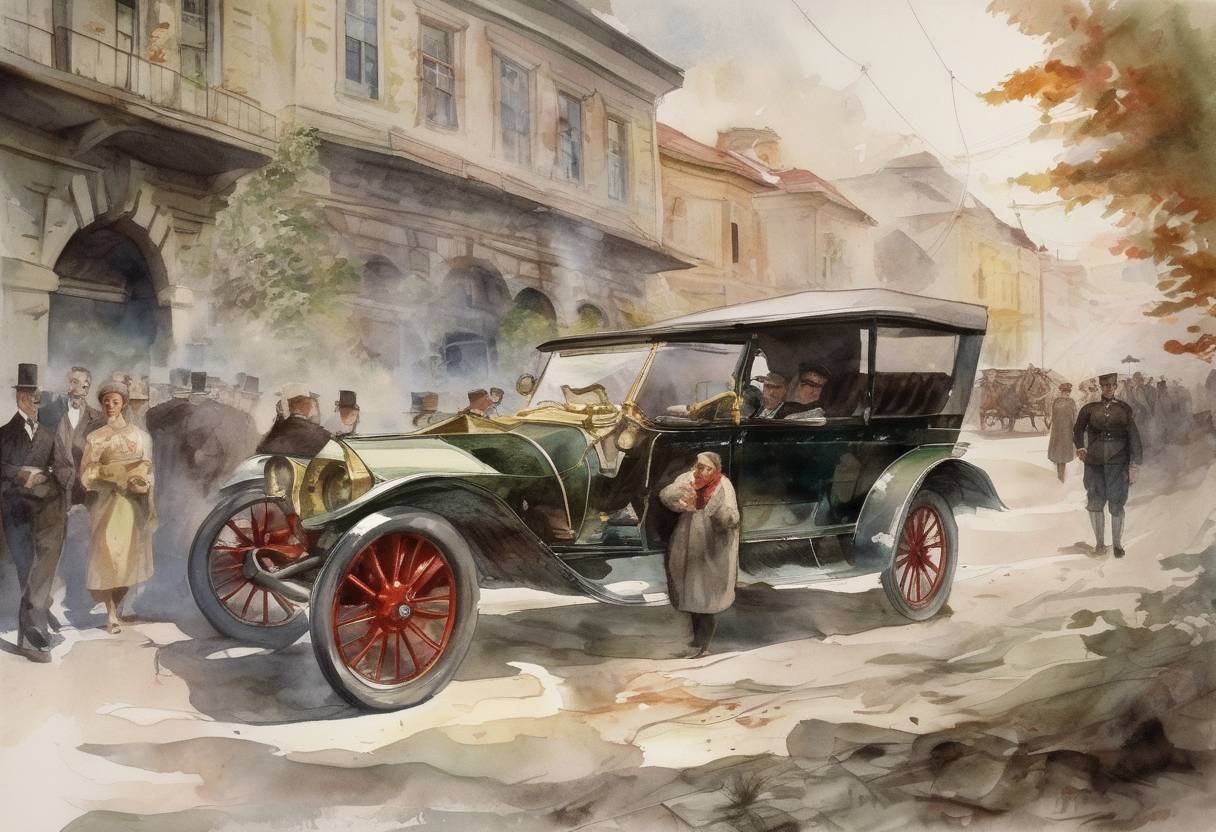
On June 28, 1914, Archduke Franz Ferdinand of Austria and his wife, Sophie, Duchess of Hohenberg, were assassinated in Sarajevo, an event that significantly contributed to the outbreak of World War I.
Franz Ferdinand was the heir presumptive to the Austro-Hungarian throne. His assassination is often cited as the immediate catalyst for World War I, though tensions had been building across Europe due to nationalism, militarism, and complex alliances.
Sophie was the wife of Franz Ferdinand. Due to her lower social status, their marriage was morganatic, meaning their children were not eligible for the throne. Despite this, the couple was known to have a strong personal bond.
The Austro-Hungarian Empire was a multi-ethnic empire facing internal strife and external pressures. Nationalist movements, particularly among Slavic groups, were gaining momentum, seeking independence or greater autonomy from imperial rule.
The assassination took place in Sarajevo, the capital of Bosnia and Herzegovina, which had been annexed by Austria-Hungary in 1908, further inflaming nationalist tensions.
The attack was carried out by Gavrilo Princip, a member of the Black Hand, a secret society committed to the creation of a Greater Serbia. Princip and his co-conspirators were motivated by nationalist sentiments and the desire to end Austro-Hungarian rule over Bosnia.
The assassination set off a chain of diplomatic events known as the July Crisis. Austria-Hungary, with the backing of Germany, issued an ultimatum to Serbia, where the assassins had ties.
The assassination highlighted the volatile nature of nationalist tensions in Europe and the fragility of peace maintained by complex alliances. It underscored the potential for localized conflicts to escalate into global wars, reshaping the political landscape of the 20th century.
The assassination of Archduke Franz Ferdinand and Sophie remains a pivotal moment in history, marking the beginning of a conflict that would have profound and lasting impacts on the world.
Source: en.wikipedia.org