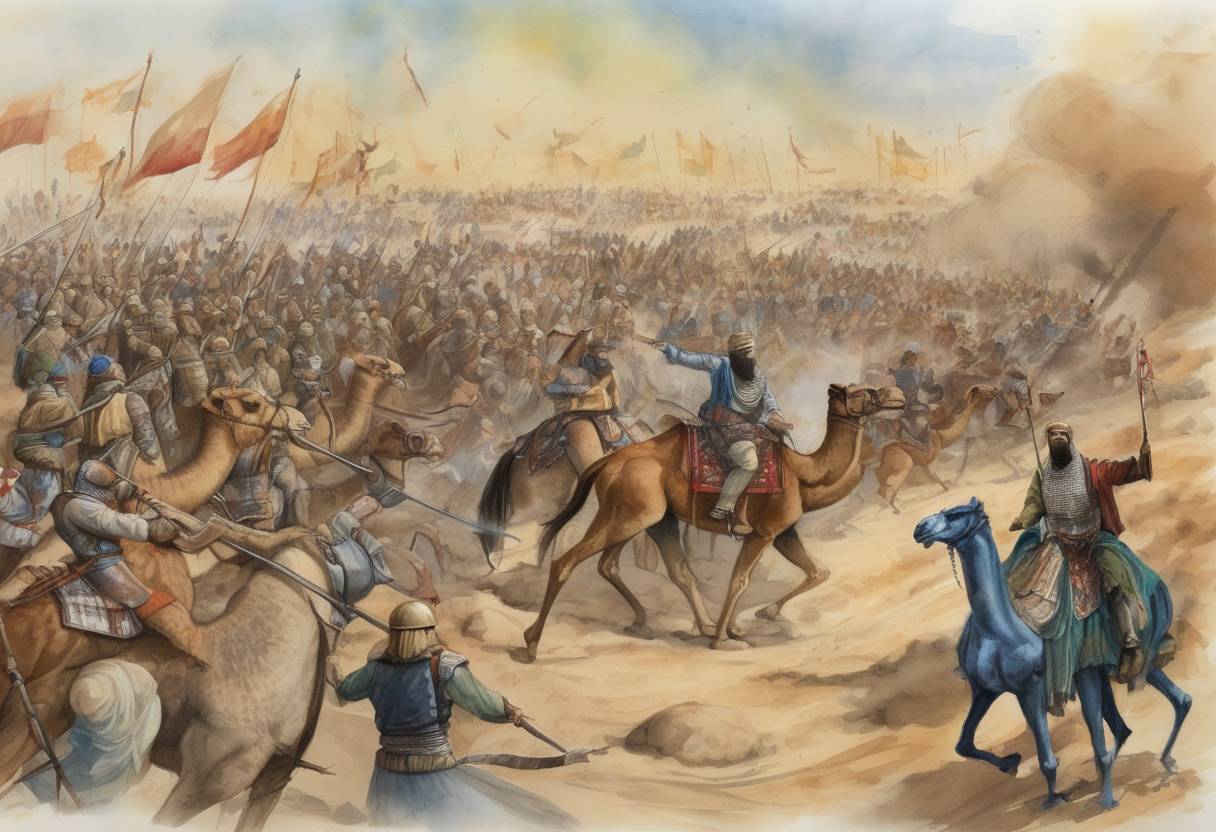
The Battle of the Camel
The Battle of the Camel, a pivotal conflict during the First Fitna, occurred on November 7, 656 CE (17th of Jumada al-Thani, 36 AH) near Basra, in present-day Iraq. This battle was a significant event in early Islamic history, marking the first major civil war within the Muslim community following the death of the Prophet Muhammad.
Background
The First Fitna, or the first Islamic civil war, was primarily a struggle for political power and leadership within the rapidly expanding Islamic state. The conflict arose after the assassination of the third caliph, Uthman ibn Affan, in 656 CE. His death led to a power vacuum and disputes over who should be the rightful leader of the Muslim community.
Ali ibn Abi Talib, the cousin and son-in-law of the Prophet Muhammad, was chosen as the fourth caliph. However, his caliphate was contested by several factions, including those who sought justice for Uthman’s murder and others who had political ambitions.
- Ali ibn Abi Talib: The fourth caliph and a central figure in the battle, leading the forces loyal to his caliphate.
- Aisha bint Abu Bakr: The widow of the Prophet Muhammad, who opposed Ali’s leadership and sought to avenge Uthman’s death.
- Talha ibn Ubaydullah and Zubair ibn al-Awam: Prominent companions of the Prophet Muhammad who allied with Aisha against Ali.
The Battle
The confrontation took place near Basra, where Aisha, Talha, and Zubair had gathered an army to challenge Ali’s authority. The battle is named after the camel that Aisha rode, which became a focal point of the fighting. The conflict was intense and resulted in significant casualties on both sides.
Despite initial resistance, Ali’s forces eventually gained the upper hand. Talha and Zubair were killed during the battle, and Aisha’s camel was brought down, leading to her capture. Ali treated Aisha with respect, ensuring her safe return to Medina.
Aftermath and Significance
The Battle of the Camel was a decisive victory for Ali, solidifying his position as caliph, albeit temporarily. However, the battle deepened the divisions within the Muslim community and set a precedent for future conflicts over leadership and governance.
The First Fitna continued after the Battle of the Camel, with further challenges to Ali’s rule, most notably from Muawiya ibn Abi Sufyan, the governor of Syria. These conflicts ultimately led to the establishment of the Umayyad Caliphate.
The Battle of the Camel remains a significant event in Islamic history, symbolizing the complexities of leadership and the challenges of maintaining unity within a rapidly expanding and diverse community.