The Chinese Nationalist Government Moves to Taiwan: December 7, 1949
1949 · Taipei, Taiwan
The Chinese Nationalist government moves from mainland China to Taiwan.
August 26, 1945
Chinese Communists and Nationalists agree to a ceasefire in their civil war at the behest of U.S. envoy George C. Marshall.
Chongqing, China | Chinese Government
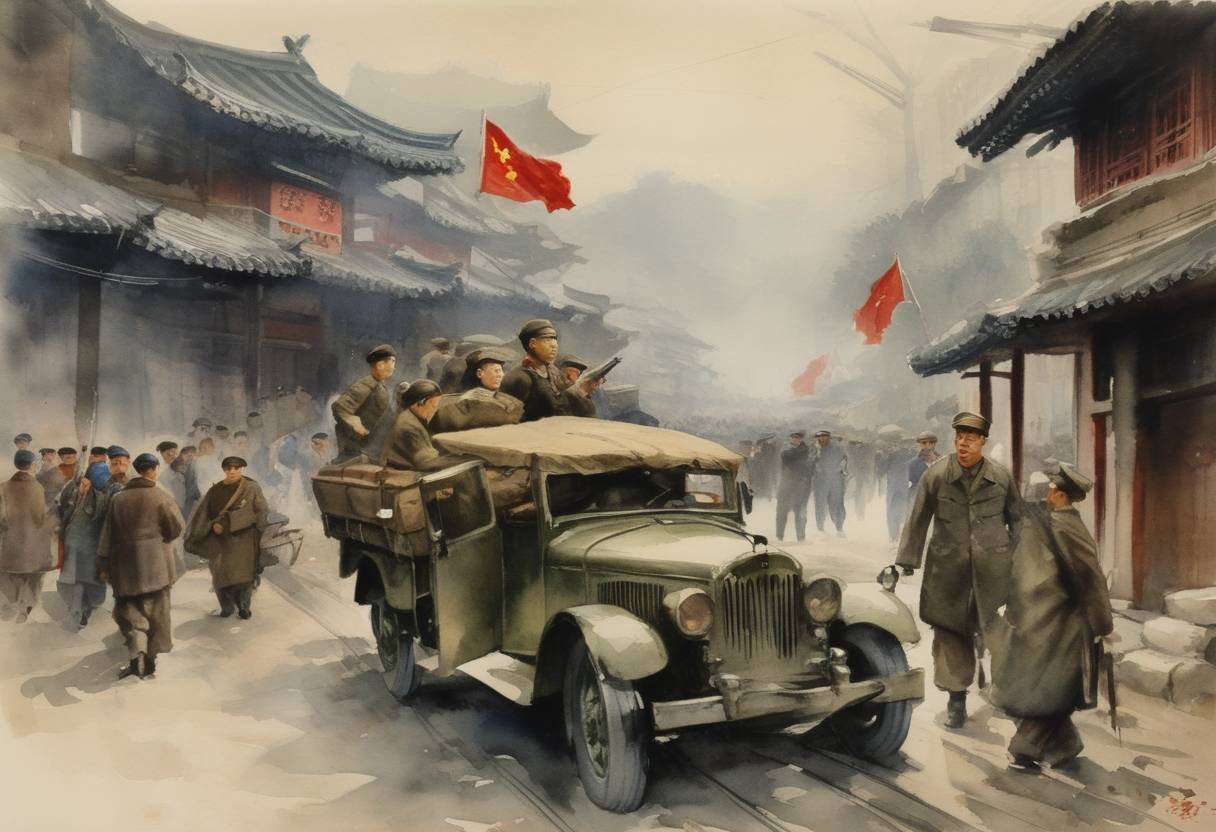
On August 26, 1945, the Chinese Communist and Nationalist forces agreed to a ceasefire, marking a momentous pause in the volatile and protracted Chinese Civil War. This temporary halt in hostilities was brokered by United States envoy General George C. Marshall, who was sent by President Harry S. Truman to mediate peace between the two sides.
The Chinese Civil War, which erupted after the end of World War II, pitted the Chinese Nationalist Party, or Kuomintang (KMT), led by Chiang Kai-shek, against the Chinese Communist Party (CCP), under the leadership of Mao Zedong. The rivalry between these two factions began in the 1920s and escalated following the Japanese invasion of China, during which they formed a tenuous alliance against a common enemy. However, as the conclusion of World War II loomed, the deep-rooted distrust and differing ideologies resurfaced, setting the stage for a full-scale civil war.
President Truman tasked General George C. Marshall with the sensitive mission to broker peace in China, thus preventing an outright civil war. Marshall, a distinguished military leader during World War II, brought his extensive diplomatic experience to the table. His mission was part of a larger U.S. strategy to stabilize China, fearing that unchecked internal conflict could lead to a Communist victory and disrupt the balance of power in the post-war world.
Marshall’s efforts led to a temporary ceasefire agreement between the KMT and CCP on August 26, 1945. This was largely a result of Marshall’s persistent negotiations and the pressure he applied to both sides to engage in dialogue. The ceasefire aimed to create an environment conducive to more substantive peace talks that could lead to a longer-term resolution.
While the ceasefire temporarily halted violence, underlying tensions and mistrust remained. Subsequent attempts to solidify peace through negotiations witnessed fluctuating success. Just as the fragile truce hinted at potential reconciliation, the inability of both parties to agree on fundamental political issues led to the resumption of hostilities in 1946. The civil war ultimately concluded in 1949, with Mao Zedong’s Communists declaring victory and establishing the People’s Republic of China.
The ceasefire mediated by Marshall is regarded as a significant moment of international diplomatic intervention, reflecting the efforts to influence the post-war political landscape. While ultimately unsuccessful in preventing further conflict, the negotiation underscored the complexities of internal Chinese politics and the broader geopolitical strategies of the Cold War era.
Source: history.state.gov