The First Performance of Gilbert and Sullivan's Comic Opera 'H.M.S. Pinafore'
1878 · London, England
The first performance of Gilbert and Sullivan's comic opera 'H.M.S. Pinafore' took place in London.
March 14, 1885
The Mikado, a comic opera by Gilbert and Sullivan, premieres at the Savoy Theatre in London, becoming one of their most popular works.
London, United Kingdom | Savoy Theatre
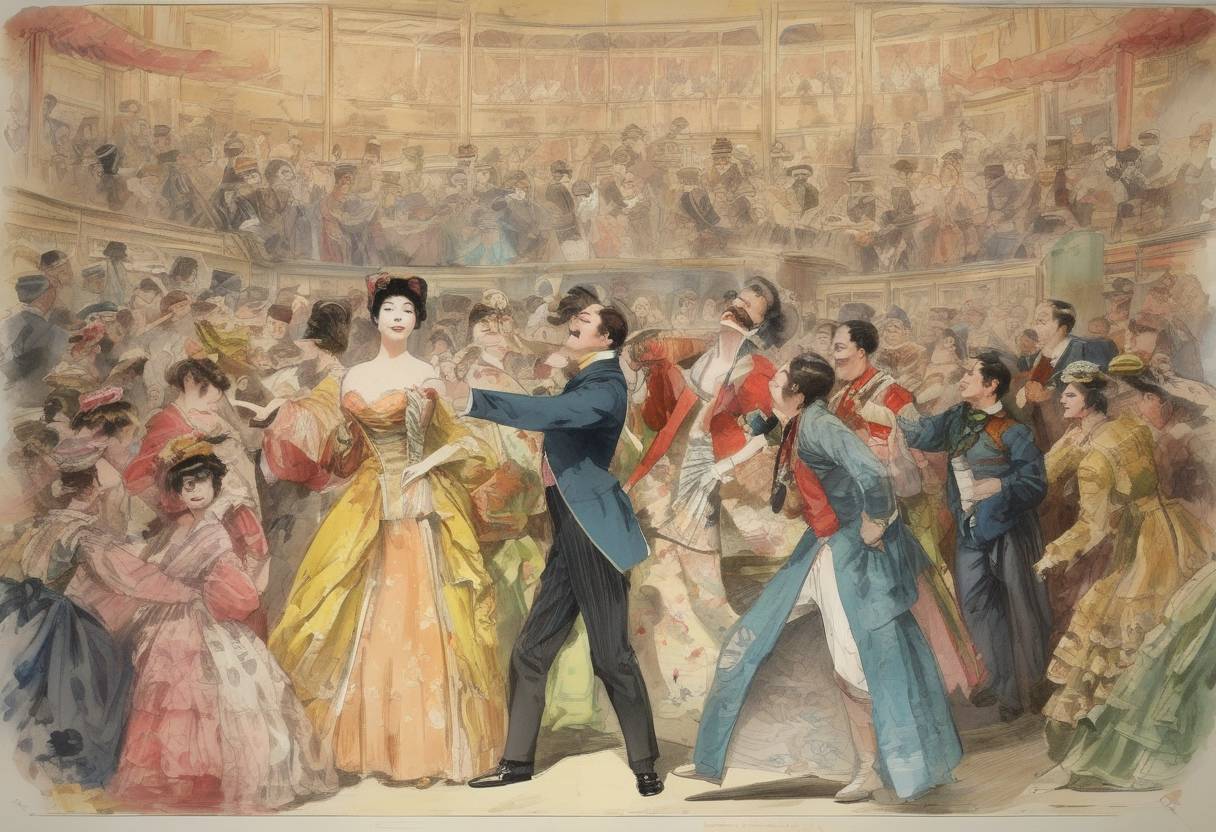
On March 14, 1885, The Mikado, a comic opera by the renowned duo W.S. Gilbert and Arthur Sullivan, premiered at the Savoy Theatre in London. This work quickly became one of their most celebrated and enduring operas, marking a significant moment in the history of musical theatre.
Gilbert and Sullivan were already well-established in the world of comic opera by the time they created The Mikado. Their partnership had produced several successful works, including H.M.S. Pinafore and The Pirates of Penzance. The duo was known for their ability to blend witty, satirical librettos with memorable and engaging music.
The Mikado is set in the fictional Japanese town of Titipu. The opera satirizes British politics and institutions through its exotic setting, allowing Gilbert and Sullivan to critique society under the guise of a far-off land. The story revolves around Nanki-Poo, the son of the Mikado (the emperor of Japan), who is in disguise and in love with Yum-Yum, the ward of Ko-Ko, the Lord High Executioner. The opera unfolds with a series of comedic misunderstandings and clever plot twists, characteristic of Gilbert’s sharp wit.
The choice of a Japanese setting was influenced by the growing fascination with Japanese culture in Britain during the late 19th century, a period often referred to as “Japonisme.” This interest was sparked by Japan’s opening to the West and the subsequent influx of Japanese art and artifacts into Europe. While The Mikado reflects this cultural fascination, it is important to note that the opera’s portrayal of Japan is a Western fantasy rather than an accurate depiction.
Upon its premiere, The Mikado was met with critical acclaim and immense popularity. It ran for 672 performances at the Savoy Theatre, a remarkable achievement for the time. The opera’s success was not limited to London; it quickly spread to other parts of the world, including the United States and Australia.
The enduring popularity of The Mikado can be attributed to its engaging music, clever lyrics, and universal themes of love, power, and societal critique. Songs like “A Wand’ring Minstrel I” and “Three Little Maids from School Are We” remain iconic in the world of musical theatre.
The Mikado stands as a testament to the creative genius of Gilbert and Sullivan and their ability to craft works that resonate with audiences across generations. It also highlights the cultural exchanges between East and West during the late 19th century, albeit through a lens of Western interpretation.
In summary, the premiere of The Mikado on March 14, 1885, marked a pivotal moment in the history of comic opera, showcasing the enduring appeal of Gilbert and Sullivan’s work and their influence on the development of musical theatre.
Source: en.wikipedia.org