Constantius III Elevated to Co-Emperor of the Western Roman Empire
421 · Ravenna, Western Roman Empire
Constantius III is elevated to the rank of co-emperor of the Western Roman Empire alongside Honorius.
October 31, 0475
Romulus Augustulus is proclaimed Western Roman Emperor.
Ravenna, Western Roman Empire | Western Roman Empire
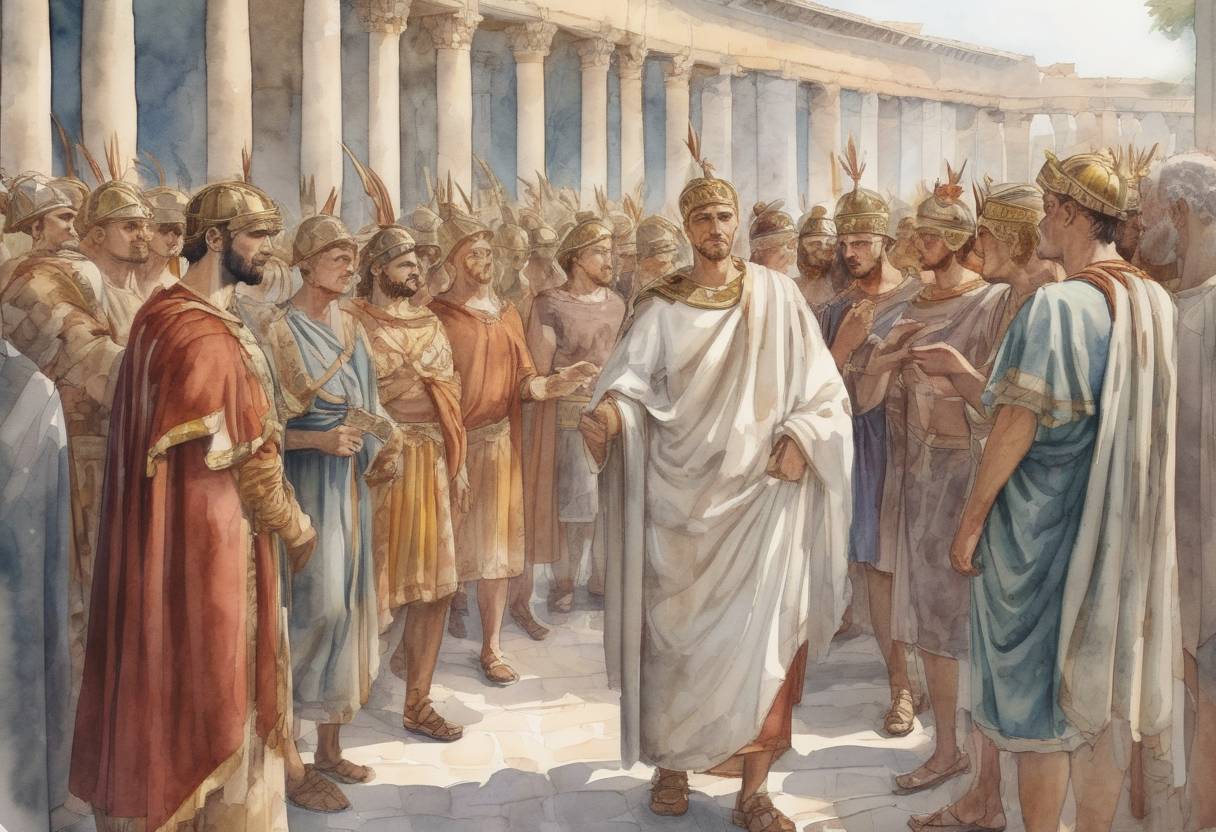
On October 31, 475, Romulus Augustulus was proclaimed the Western Roman Emperor, marking a significant yet somber moment in the history of the Roman Empire. His ascension to the throne is often viewed as a prelude to the eventual fall of the Western Roman Empire.
The Western Roman Empire, by the mid-5th century, was in a state of decline. It faced continuous internal strife, economic troubles, and pressure from various barbarian groups. The political landscape was unstable, with frequent changes in leadership and power struggles among military leaders and Roman aristocrats.
Romulus Augustulus was the son of Orestes, a Roman general of Pannonian origin who had previously served under Attila the Hun. Orestes seized power in 475, forcing the then-emperor, Julius Nepos, to flee to Dalmatia. With control over the military and the political apparatus, Orestes placed his young son, Romulus, on the throne.
Romulus Augustulus was a mere teenager at the time of his proclamation, and his reign was largely symbolic. He was often referred to as “Augustulus,” a diminutive form of “Augustus,” highlighting his youth and the lack of real power he wielded. The true power lay with his father, Orestes, who acted as the de facto ruler.
During Romulus’s brief reign, the Western Roman Empire continued to face significant challenges. The empire’s territories had shrunk considerably, and its authority was limited primarily to Italy. The Eastern Roman Empire, centered in Constantinople, was the more stable and powerful of the two halves of the once-unified Roman Empire.
Romulus Augustulus’s reign lasted less than a year. In 476, Odoacer, a Germanic chieftain and leader of the foederati (barbarian troops in Roman service), rebelled against Orestes. Odoacer’s forces captured and executed Orestes, and Romulus was forced to abdicate on September 4, 476.
Odoacer chose not to assume the title of emperor. Instead, he declared himself the ruler of Italy and sent the imperial insignia to the Eastern Roman Emperor, Zeno, effectively ending the Western Roman Empire. This event is traditionally marked as the fall of the Western Roman Empire, although the Eastern Roman Empire, known as the Byzantine Empire, continued to thrive for nearly a thousand more years.
The proclamation of Romulus Augustulus as emperor and his subsequent fall symbolize the end of ancient Rome’s imperial power in the West. His brief reign is often seen as the final chapter in the decline of the Western Roman Empire, a process that had been unfolding over several decades due to internal decay and external pressures.
Romulus Augustulus himself faded into obscurity after his abdication. Historical records suggest he was allowed to live out his life in relative peace, possibly in the region of Campania, with a pension provided by Odoacer.
The fall of the Western Roman Empire had profound implications for Europe, leading to the fragmentation of territories and the rise of various barbarian kingdoms. It marked the beginning of the Middle Ages, a period characterized by the transformation of Roman institutions and the emergence of new political and cultural entities across the continent.
Source: en.wikipedia.org