President Dwight D. Eisenhower's Farewell Address
1961 · Washington, D.C., United States
President Dwight D. Eisenhower delivers his farewell address to the nation, warning of the dangers of the military-industrial complex.
April 7, 1954
U.S. President Dwight D. Eisenhower gives his "domino theory" speech during a news conference, explaining why the United States should continue to support French Indochina.
Washington, D.C., United States | U.S. Government
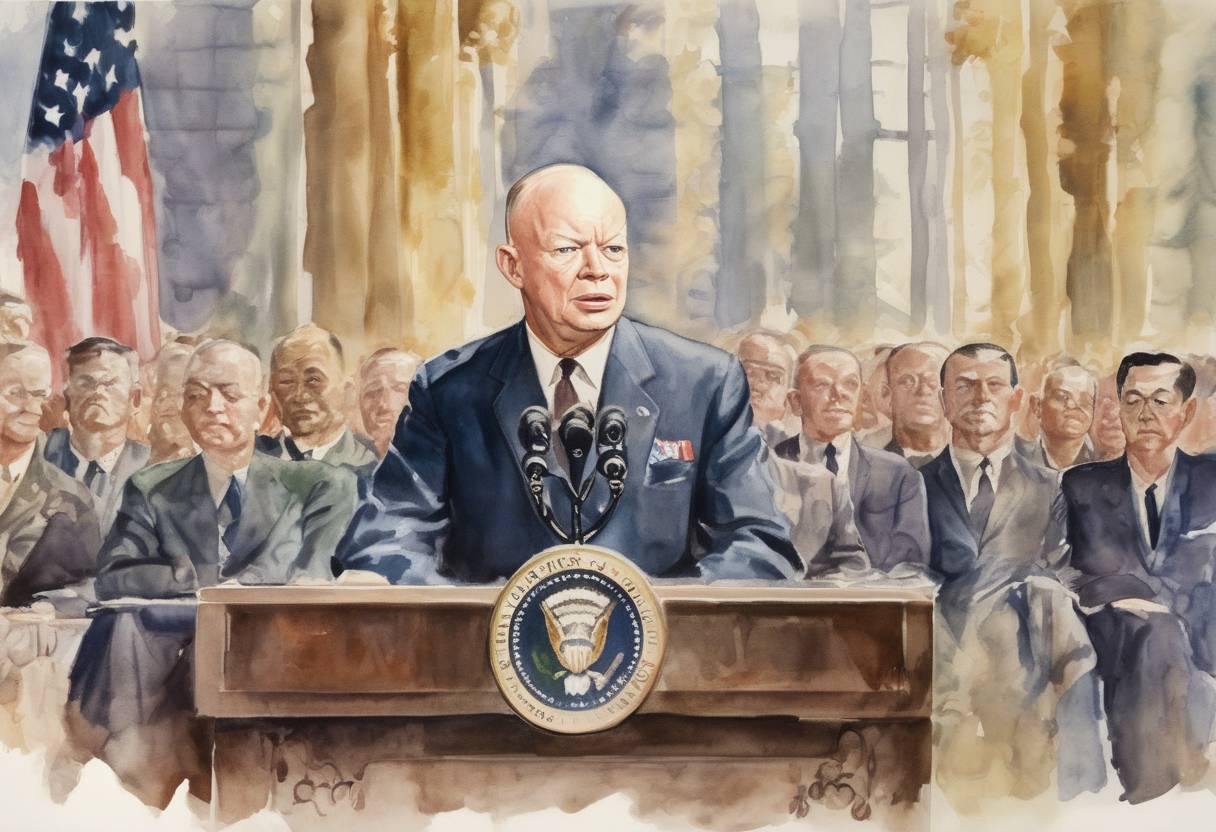
On April 7, 1954, U.S. President Dwight D. Eisenhower articulated what would become known as the “domino theory” during a news conference. This theory was a pivotal moment in Cold War geopolitics and played a significant role in shaping U.S. foreign policy, particularly in Southeast Asia.
French Indochina Conflict: By the early 1950s, French colonial forces were embroiled in a conflict with the Viet Minh, a communist-led nationalist movement in Vietnam. The struggle was part of a broader decolonization wave following World War II.
Cold War Tensions: The Cold War between the United States and the Soviet Union was intensifying. The U.S. was committed to containing the spread of communism worldwide, following the Truman Doctrine’s principles.
U.S. Involvement: The United States had been providing financial and military support to the French in Indochina, viewing the conflict as part of the global struggle against communism.
Domino Theory Explanation: Eisenhower explained the “domino theory” by suggesting that the fall of one nation to communism could trigger a chain reaction, leading to the fall of neighboring countries. He famously stated that the loss of Indochina would lead to the loss of Southeast Asia, likening it to a row of dominoes falling one after another.
Strategic Importance: Eisenhower emphasized the strategic and economic importance of Southeast Asia, noting its resources and the potential impact on global trade routes.
Justification for Support: The speech was intended to justify continued U.S. support for French efforts in Indochina, framing it as essential to preventing the spread of communism.
U.S. Policy in Vietnam: The domino theory became a cornerstone of U.S. policy in Vietnam, eventually leading to increased American involvement in the region, culminating in the Vietnam War.
Criticism and Debate: Over time, the validity of the domino theory was debated. Critics argued that it oversimplified complex regional dynamics and underestimated nationalist movements’ motivations.
Legacy: Despite its controversies, the domino theory influenced U.S. foreign policy decisions throughout the Cold War, reinforcing the perception of a monolithic communist threat.
Eisenhower’s articulation of the domino theory on April 7, 1954, marked a significant moment in Cold War history, illustrating the U.S. commitment to containing communism and shaping its engagement in Southeast Asia for decades to come.
Source: en.wikipedia.org