Nobel Prize in Economics Awarded to Jean Tirole
2014 · Stockholm, Sweden
The Nobel Prize in Economics was awarded to French economist Jean Tirole for his analysis of market power and regulation.
October 4, 2017
The Nobel Prize in Chemistry is awarded to Jacques Dubochet, Joachim Frank, and Richard Henderson for developing cryo-electron microscopy.
Stockholm, Sweden | Royal Swedish Academy of Sciences
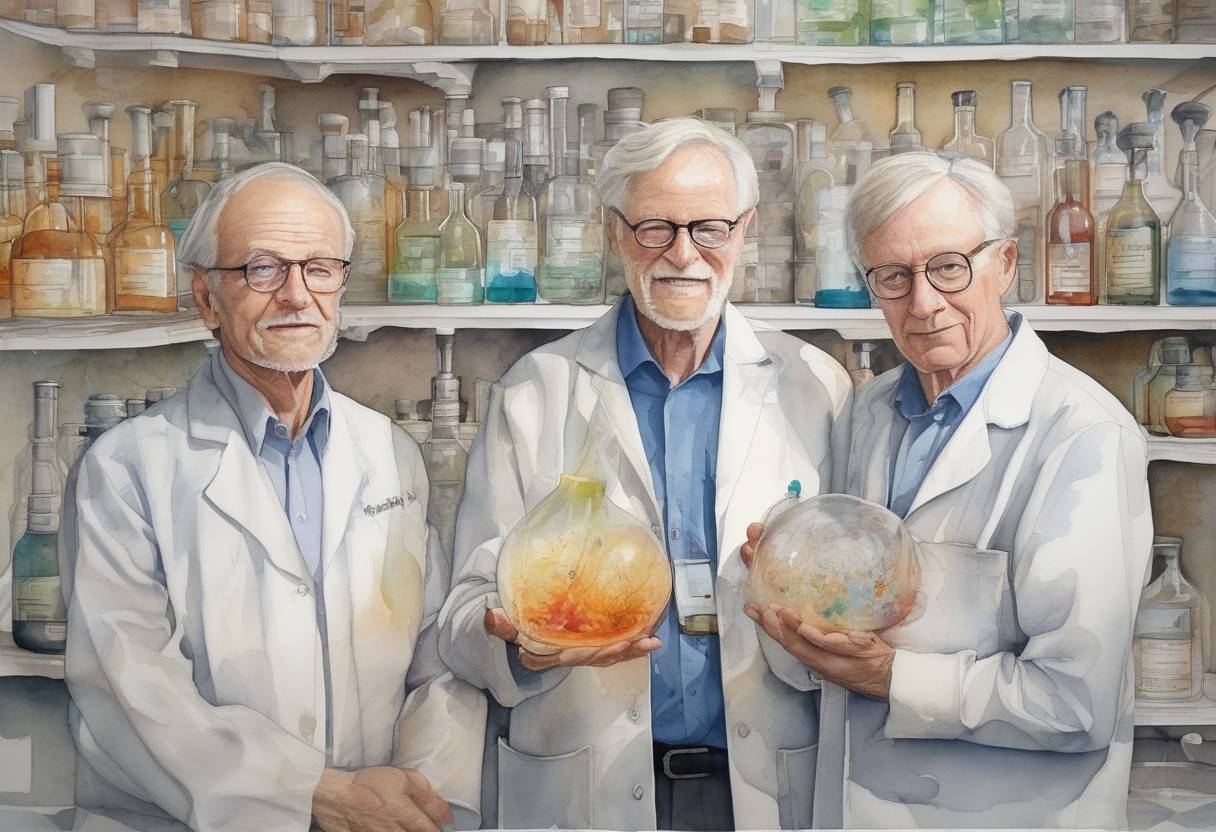
On October 4, 2017, the Nobel Prize in Chemistry was awarded to Jacques Dubochet, Joachim Frank, and Richard Henderson for their pioneering work in the development of cryo-electron microscopy. This groundbreaking technique revolutionized the field of biochemistry by allowing scientists to visualize biomolecules in unprecedented detail.
Cryo-electron microscopy is a form of electron microscopy where samples are studied at cryogenic temperatures. This method enables the observation of specimens that have been rapidly frozen, preserving their natural structure without the need for dyes or fixatives that could alter their form.
Jacques Dubochet: Dubochet’s contribution was crucial in the development of vitrification, a process that involves rapidly freezing water around a biological sample to form a glass-like solid. This prevents the formation of ice crystals that could damage the sample and distort the image.
Joachim Frank: Frank developed image processing methods that allowed for the transformation of the two-dimensional images produced by electron microscopes into three-dimensional structures. His work enabled the visualization of complex biomolecules with high precision.
Richard Henderson: Henderson was instrumental in demonstrating that electron microscopy could be used to determine the structure of proteins at atomic resolution. His work with bacteriorhodopsin, a membrane protein, proved that electron microscopy could achieve resolutions comparable to X-ray crystallography.
The development of cryo-electron microscopy has had a profound impact on structural biology. It allows scientists to visualize the architecture of proteins, viruses, and other biomolecules in their native states, providing insights into their function and mechanisms. This has accelerated drug discovery and the development of new therapies for diseases.
Medical Research: Cryo-EM has been pivotal in understanding the structures of complex proteins involved in diseases such as Alzheimer’s and cancer, aiding in the development of targeted treatments.
Biological Discoveries: The technique has enabled numerous discoveries in cell biology and virology, including detailed images of the Zika virus and ribosomes.
The awarding of the Nobel Prize in Chemistry to Dubochet, Frank, and Henderson in 2017 recognized their significant contributions to the field of biochemistry and the transformative impact of cryo-electron microscopy. Their work has opened new avenues for scientific exploration and has become an indispensable tool in modern biological research.
Source: www.nobelprize.org