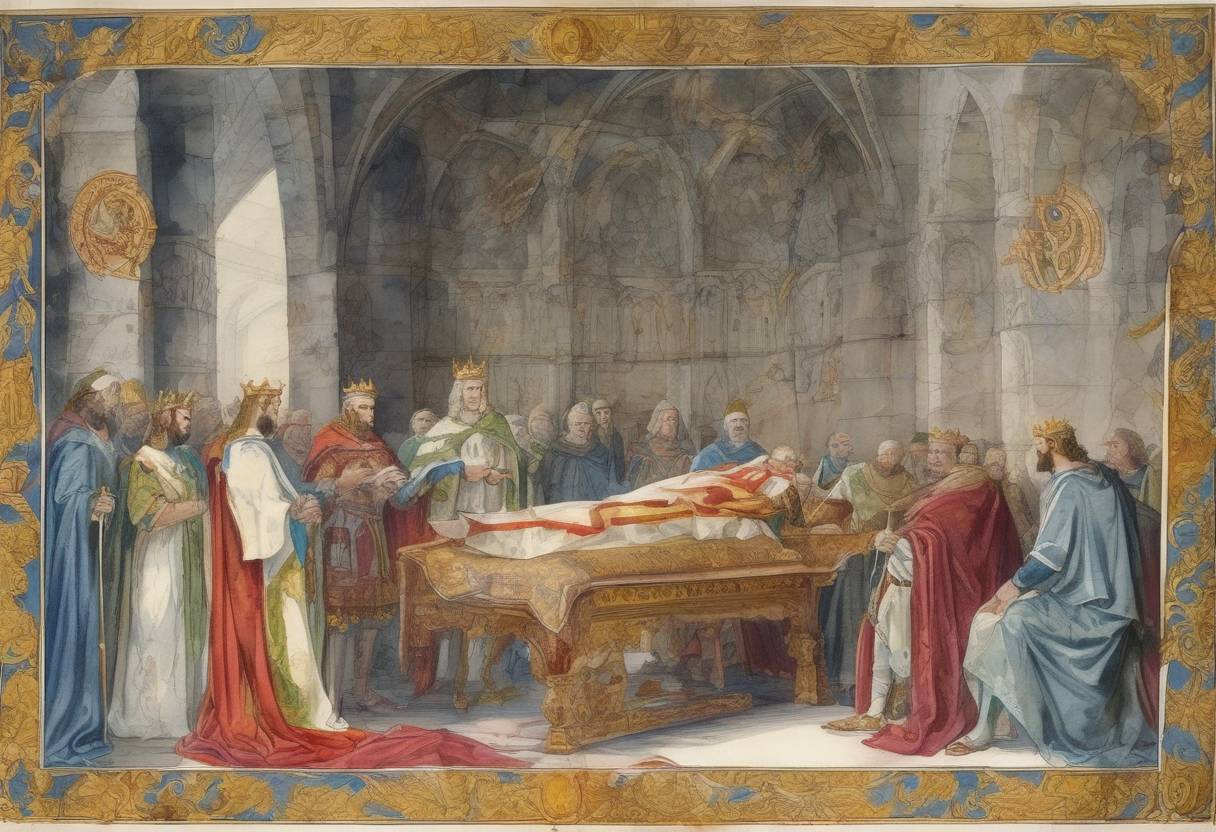
The Death of Lothair I and the Treaty of Prüm
On September 29, 855, Lothair I, the Holy Roman Emperor, passed away, an event that significantly influenced the political landscape of medieval Europe. His death led to the Treaty of Prüm, which played a crucial role in the fragmentation of the Carolingian Empire.
Background
Lothair I was born in 795, the eldest son of Emperor Louis the Pious and grandson of Charlemagne. As a member of the Carolingian dynasty, Lothair was deeply involved in the complex politics of the empire, which was characterized by frequent divisions and disputes over succession.
In 817, Lothair was made co-emperor with his father, and in 843, following the Treaty of Verdun, he became the ruler of Middle Francia, a region that stretched from the North Sea to Italy, including parts of modern-day France, Germany, and Italy. This treaty was an attempt to resolve conflicts among Louis the Pious’s sons, but it also laid the groundwork for future fragmentation.
The Treaty of Prüm
Upon Lothair’s death in 855, the Treaty of Prüm was enacted to divide his kingdom among his three sons:
- Louis II received Italy and the imperial title, becoming King of Italy and continuing the legacy of the Holy Roman Empire.
- Lothair II was granted Lotharingia, a region named after him, which included parts of present-day Belgium, the Netherlands, and western Germany.
- Charles received Provence, a region in the southeastern part of modern-day France.
This division was in line with the Carolingian tradition of partitioning territories among heirs, a practice that often weakened centralized control and contributed to the empire’s fragmentation.
Consequences
The Treaty of Prüm and the subsequent division of Lothair I’s realm had several significant consequences:
- Fragmentation of Power: The division of territories among multiple heirs diluted the power of the central authority, leading to increased regional autonomy and the eventual decline of Carolingian control.
- Rise of Regional Identities: As territories became more autonomous, distinct regional identities began to emerge, setting the stage for the development of modern European nations.
- Continued Conflict: The partitioning of the empire did not resolve underlying tensions, leading to further conflicts among the Carolingian heirs and contributing to the political instability of the period.
Historical Significance
The death of Lothair I and the Treaty of Prüm are pivotal in understanding the decline of the Carolingian Empire. The fragmentation that resulted from this division exemplifies the challenges of maintaining a vast empire with multiple heirs, a recurring theme in medieval European history. This period set the stage for the eventual rise of feudalism and the formation of distinct European states in the centuries to follow.