The Third Battle of Panipat: January 14, 1761
1761 · Panipat, India
The Third Battle of Panipat takes place, marking a significant conflict between the Maratha Empire and the Durrani Empire in India.
February 24, 1739
The Battle of Vasai occurs during the First Anglo-Maratha War, where Maratha forces under Chimaji Appa capture the Portuguese fort of Vasai.
Vasai, India | Maratha Empire
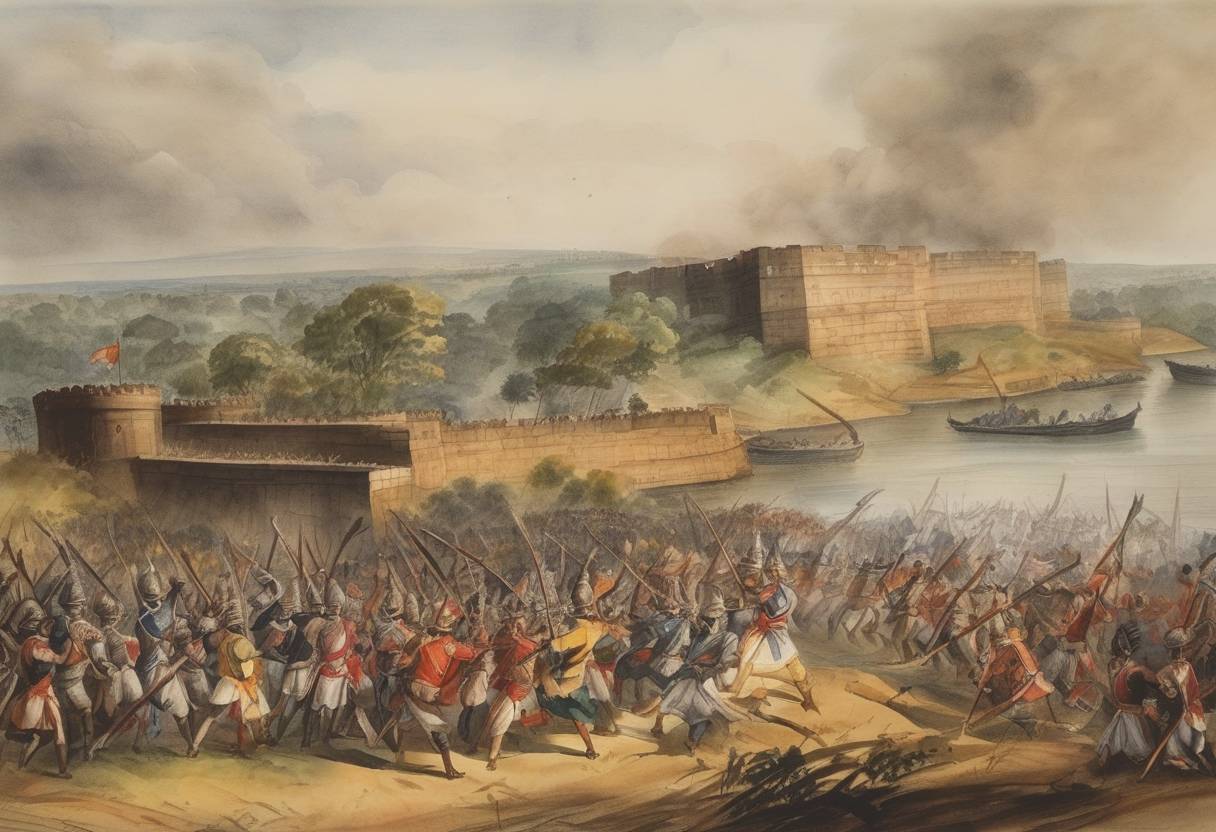
The Battle of Vasai stands as a key moment during the First Anglo-Maratha War, marked by the decisive capture of the Portuguese-controlled fort of Vasai on February 24, 1739. This battle was led by Chimaji Appa, a prominent Maratha leader and the younger brother of Peshwa Baji Rao I, against the established Portuguese monarchic power in India.
Vasai, then known as Bassein, was a strategic coastal town controlled by the Portuguese. They had held this territory since the early 16th century, using it as a vital commercial and military outpost. The fortification of Vasai was crucial, as it allowed Portugal to control maritime trade routes as well as exert influence over the neighboring regions.
In the broader scope of the First Anglo-Maratha War (1775–1782), which was primarily a conflict between the British East India Company and the Maratha Empire, the rivalry between Maratha forces and European colonizers frequently ignited local conflicts. The Marathas, in their quest to consolidate control over the western coast of India, set their sights on the expulsion of the Portuguese from Vasai.
Under the command of Chimaji Appa, the Maratha forces launched a campaign to seize Vasai in 1737. Following a prolonged siege that lasted several months, characterized by strategic blockades and multiple skirmishes, the Marathas intensified their efforts. Armed with heavy artillery and leveraging their knowledge of the local geography, they managed to breach the Portuguese defenses.
On February 24, 1739, the Marathas successfully captured the fort of Vasai, marking a significant victory that underscored their military prowess and the declining power and influence of the Portuguese in the region. The fall of Vasai was a symbolic and decisive defeat for the Portuguese, highlighting the shift in power dynamics on the Indian subcontinent during that period.
The capture of Vasai significantly bolstered the territorial and strategic advantages of the Maratha Empire in western India. It also demonstrated the eroding influence of European colonial powers on the Indian mainland during the mid-18th century. Following this victory, Maratha forces continued their expansion, setting the stage for further conflicts with other colonial powers, such as the British, and maintaining their prominence as a formidable regional power.
The Battle of Vasai remains a testament to the military acumen of Chimaji Appa and his successful strategy in challenging European fortifications. This victory also contributed to the decline of Portuguese influence, pivoting the Marathas into a more dominant position in the region.
Source: en.wikipedia.org