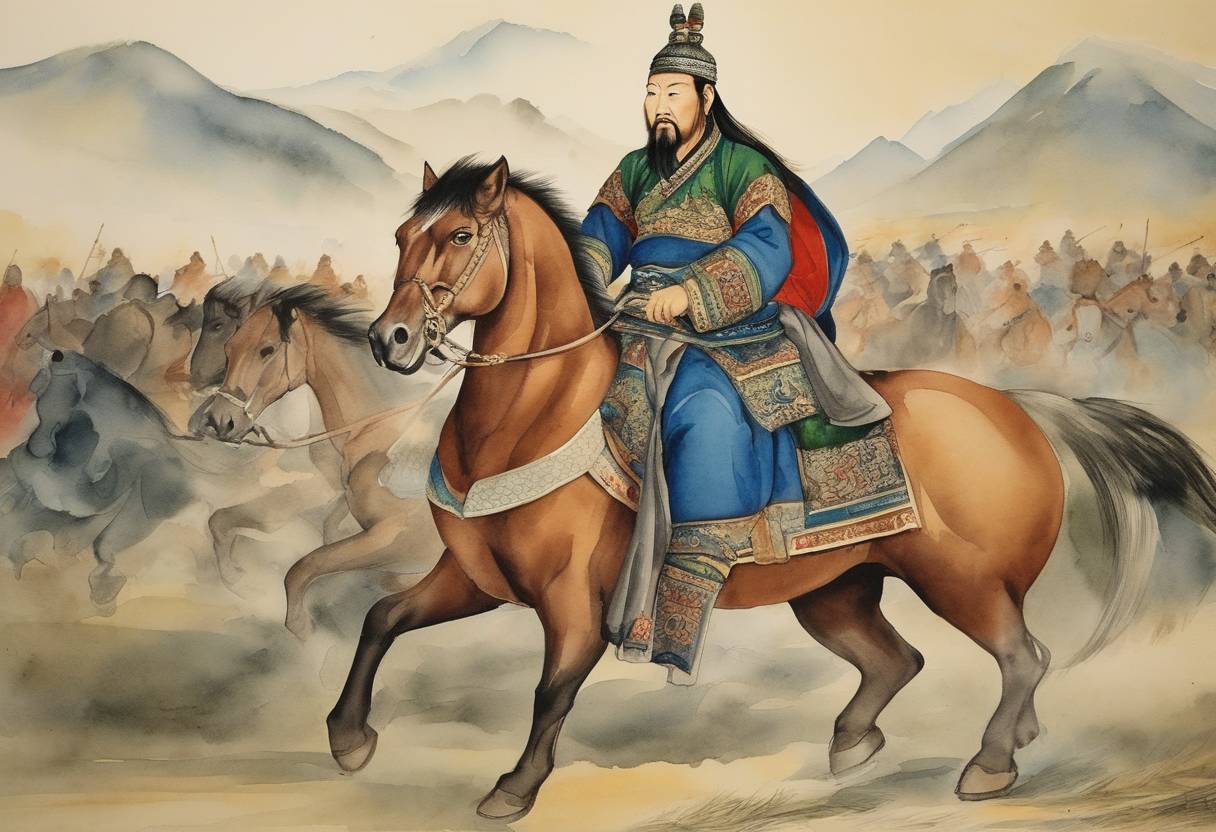
Kublai Khan: Birth and Historical Context
Kublai Khan, the renowned Mongol leader and founder of the Yuan dynasty in China, was born on September 23, 1215. Therefore, the date June 13, 1165, seems incorrect for his birth. Nonetheless, Kublai Khan is a figure of immense historical significance.
Early Life
Kublai was the grandson of Genghis Khan, the founder of the Mongol Empire, which became the largest contiguous empire in world history. Born to Tolui and Sorghaghtani Beki, Kublai grew up in a period where the Mongol Empire was rapidly expanding across Asia and Europe. From a young age, he was deeply influenced by his family’s conquests and the administrative responsibilities that came with it.
Rise to Power
Kublai’s ascendancy to power was characterized by his position as a prominent general and administrator within the Mongol hierarchy. His early appointments involved governing Northern China, during which he demonstrated skill in managing diverse populations and economies.
In 1260, following the death of his brother, Möngke Khan, Kublai declared himself the Great Khan of the Mongol Empire amidst a succession struggle. Although his claim was not uncontested within the Mongol khanates, he gradually consolidated power with successful military campaigns and strategic diplomatic maneuvers.
Founding of the Yuan Dynasty
In 1271, Kublai Khan proclaimed the establishment of the Yuan dynasty in China, marking a significant transformation. The Yuan dynasty, lasting until 1368, connected China more closely with the rest of the Mongol Empire, fostering cultural exchanges and economic prosperity along the Silk Road. Kublai moved the capital to Dadu, present-day Beijing, integrating Chinese administrative practices with Mongolian customs.
Legacy
Kublai Khan’s reign witnessed significant advancements such as the construction of infrastructure, including the Grand Canal, and fostering of trade and cultural exchange. The Yuan dynasty influenced subsequent Chinese history, leaving a legacy of mixed Mongol-Chinese governance that would shape the region’s future.
Kublai Khan’s rule marked the height of Mongol power in China, although his successors struggled to maintain control, eventually leading to the fall of the Yuan dynasty. His effective administration and openness to cultural influences have established him as one of the most significant figures in Mongolian and Chinese history.