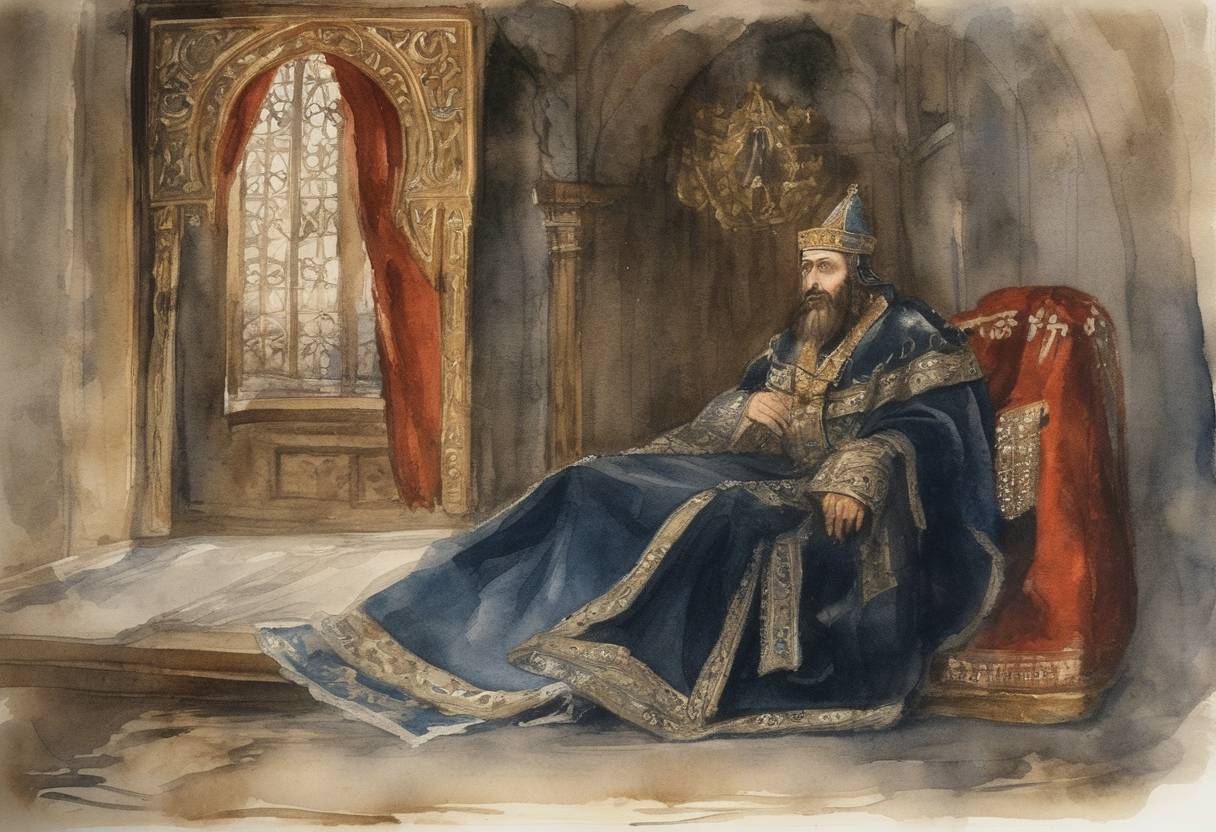
Ivan the Terrible’s Death - March 28, 1584
Ivan IV Vasilyevich, commonly known as Ivan the Terrible, passed away on March 28, 1584. His death, reputedly due to a stroke, marked the end of a tumultuous reign that significantly influenced Russia’s political landscape.
Background
Ivan IV was born in 1530 and became Grand Prince of Moscow in 1533. In 1547, he was crowned the first Tsar of All Russia, signifying a move towards centralized royal authority. This title underscored his ambition to establish Moscow as the successor to the Byzantine Empire’s legacy.
Reign Highlights
Ivan’s reign can be divided into two distinct periods:
The Reforms (1547-1560): Initially, Ivan enacted reforms aimed at modernizing Russia. He established the Zemsky Sobor, a national assembly, and reorganized the military. His kingdom saw the expansion of the Russian territory, which included conquests such as the Khanates of Kazan and Astrakhan.
The Oprichnina (1565-1572): The later years of Ivan’s rule were marked by his establishment of the Oprichnina—a policy characterized by mass repressions, executions, and the confiscation of land from the nobility. This period is often cited as a precursor to modern totalitarianism, contributing to Ivan’s nickname, “the Terrible.”
Death and Legacy
Ivan the Terrible died in Moscow in 1584. His erratic and often violent governance left Russia deeply divided, and his death led to a period of political instability known as the Time of Troubles. Historically, Ivan is recognized for:
- Territorial Expansion: His conquests centralized power in Moscow, laying the groundwork for the later Russian Empire.
- Centralization of Power: Ivan’s policies weakened the traditional aristocracy, consolidating power within the monarchy.
- Cultural and Political Isolation: His autocratic style and internal campaigns set a precedent for future rulers, influencing Russian governance for centuries.
His son, Feodor I, succeeded him, though actual power soon fell into the hands of Boris Godunov. Ivan’s reign remains one of the most studied periods in Russian history, symbolizing the complex interplay of tyranny and modernization.