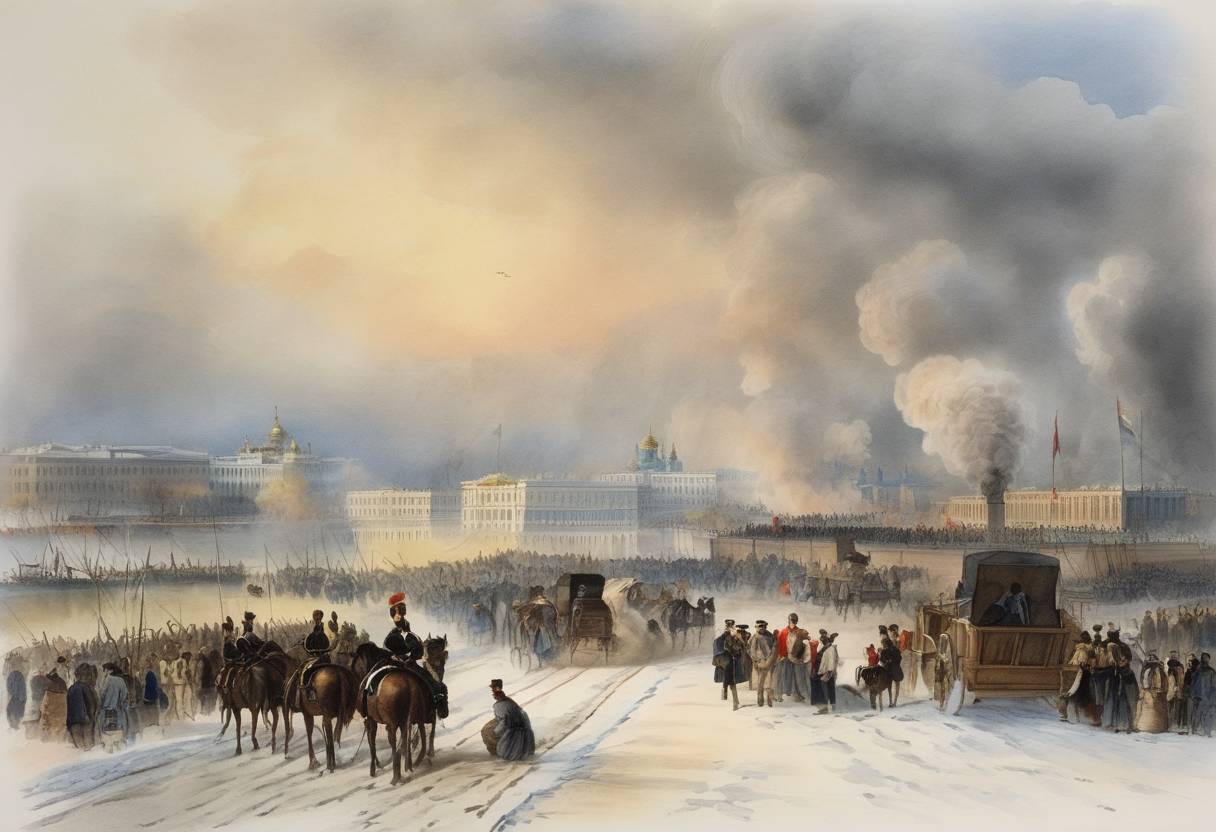
Burial of Tsar Alexander I of Russia
1825 · Saint Petersburg, Russia
Russia's Tsar Alexander I was buried in the Saints Peter and Paul Cathedral in Saint Petersburg.
April 26, 1828
Russia declares war on the Ottoman Empire, marking the start of the Russo-Turkish War of 1828–1829.
Saint Petersburg, Russia | Russian Empire
On April 26, 1828, the Russian Empire formally declared war on the Ottoman Empire, initiating the Russo-Turkish War of 1828–1829. This declaration marked a significant escalation in the long-standing conflict between the two empires, rooted in territorial disputes and the complex dynamics of power in Eastern Europe and the Balkans.
The early 19th century was a period of tumultuous change within Europe and the Ottoman territories. The decay of Ottoman power and the shifting allegiances among European powers set the stage for new conflicts. The Greek War of Independence, which began in 1821, heightened tensions, with Russia expressing strong support for the Greek cause due to cultural and religious ties and perceived Ottoman atrocities against Orthodox Christians.
The Treaty of Adrianople (1826), concluded a previous Russo-Turkish conflict, failed to address underlying frictions and left Russia dissatisfied with the Ottoman concessions. Additional provocations, such as the Ottoman Empire’s refusal to recognize the treaties concerning Serbian autonomy brokered by Russia, further encouraged Russian intervention.
On April 26, 1828, Tsar Nicholas I declared war on the Ottoman Empire following a series of diplomatic failures and provocations. Russia’s apparent goal was to secure dominance in the Black Sea region and to extend its influence over the declining Ottoman territories in the Balkans and the Caucasus.
The war saw several decisive engagements, with Russian forces advancing both in the Danubian Principalities (modern-day Romania) and the Caucasus region. Utilizing superior military organization and modern tactics, the Russian army achieved significant victories despite difficult supply lines and harsh terrain.
The war concluded with the signing of the Treaty of Adrianople on September 14, 1829. The treaty significantly favored Russia, granting it new territories in the Caucasus and the Black Sea region and securing additional privileges for Russian merchants and ships. Additionally, the treaty called for the evacuation of Russian troops from the Danubian Principalities, which saw increased autonomy as a result.
The conflict further contributed to the weakening of the Ottoman Empire and set the stage for increasing Russian influence in Eastern Europe and the Balkans. It also underscored the shifts in power dynamics that would continue to shape European geopolitics throughout the 19th century.
Source: www.britannica.com