The Battle of Dunkeld: August 21, 1689
1689 · Dunkeld, Scotland
The Battle of Dunkeld took place in Scotland during the Jacobite rising of 1689. Government forces successfully defended the town against Jacobite forces.
July 27, 1689
The decisive Battle of Killiecrankie was fought during the Jacobite rising in Scotland. It resulted in a victory for the Jacobites led by John Graham, Viscount Dundee, despite his death in the battle.
Blair Atholl, Scotland
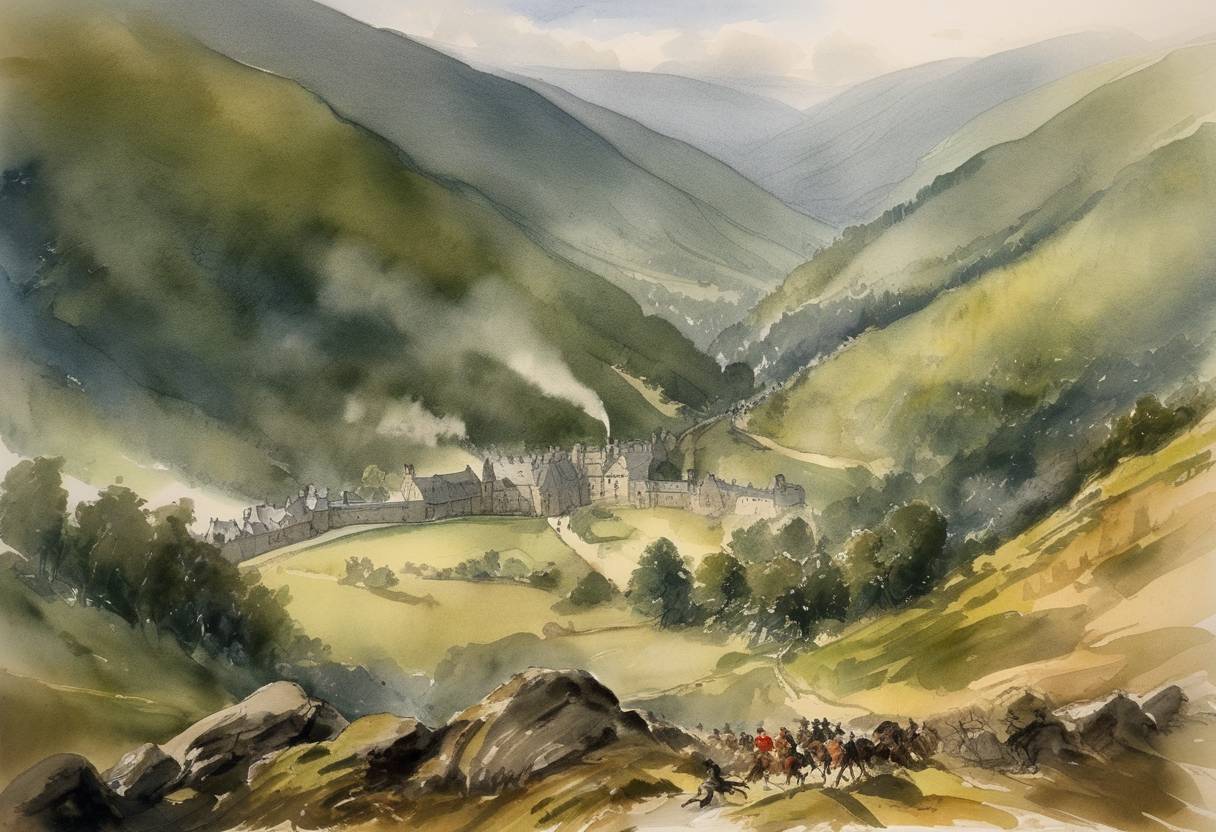
The Battle of Killiecrankie, fought on July 27, 1689, was a significant engagement during the first Jacobite rising in Scotland, which aimed to restore James VII of Scotland (James II of England) to the throne after he was deposed by William of Orange in the Glorious Revolution.
In 1688, tensions peaked when James VII, a Catholic monarch, was overthrown by the Protestant William of Orange. Resistance to this change simmered, especially in Scotland where religious and political dynamics were complex. The Jacobite cause emerged, seeking to return James to the throne. John Graham, Viscount Dundee, was a fervent supporter of James and led the Scottish highland clans who were loyal to the deposed king.
Understanding the strategic importance of controlling Scotland, Viscount Dundee rallied support among the Highland clans in spring of 1689. Despite having a smaller and less well-equipped force compared to the Williamite government troops led by General Hugh Mackay, Dundee relied on his knowledge of the rugged terrain and the fierce loyalty of his highland warriors.
The Battle of Killiecrankie took place in the narrow Pass of Killiecrankie, near the River Garry in the Scottish Highlands. Dundee’s forces, approximately 2,000 strong, faced a slightly larger government army under Mackay.
The Highland Charge: As the sun began to set, Dundee ordered a downhill charge, known as the “Highland Charge.” This tactic involved a sudden, rapid advance that aimed to quickly close the distance with the enemy, using the momentum and ferocity to break lines.
Tactical Advantage: The Jacobite forces capitalized on the element of surprise and used the terrain to their advantage. The highland charge was devastating and quickly shattered Mackay’s formations, leading to a chaotic rout.
The Jacobites achieved a decisive victory, inflicting substantial casualties on Mackay’s forces, with estimates of several thousand government troops killed or captured compared to the few hundred losses on the Jacobite side. However, this victory came at a great cost; Viscount Dundee was fatally wounded during the battle.
Dundee’s death was a severe blow to the Jacobite cause, leading to disorganization and weakening their strategic position. Despite victory at Killiecrankie, the Jacobite rising eventually faltered due to lack of coherent leadership and support. The subsequent Battle of Dunkeld saw the effective dispersal of the Jacobite forces, signaling the end of the rising.
The Battle of Killiecrankie holds a notable place in Scottish and British history as an illustration of the passionate resistance against the new regime imposed by the Glorious Revolution. It exemplified the enduring fractures within the British Isles regarding religious allegiance, monarchical legitimacy, and regional autonomy that persistently shaped British political landscapes in the following centuries.
Source: www.britannica.com